A size code does two jobs at once, and most ordering errors come from reading only one of them. “M10 × 80” tells you the thread diameter and the overall length, but it does not tell you how thick the fixture is, how deep the anchor must sit, or which drill to use. This anchor bolt size chart covers the diameters and lengths produced in this range, M6 to M20.
The sections that follow explain what each number controls, how to calculate the length you actually need, and which lengths are available per diameter. The chart is a production range, not a stock list: it tells you what can be produced and quoted, not what is sitting in a warehouse.
Why a Size Code Has Two Numbers, Not One
The first number is a thread size. The second is a length. They are independent: an M10 diameter anchor comes in nine lengths in this range, and the same length exists across several diameters.
Changing one without the other changes the installation. An M10 × 80 and an M10 × 100 share every thread dimension and none of their embedment. If the drawing says 100 and the box says 80, the anchor will either sit too shallow or fail to reach through the fixture — and the thread will not tell you anything is wrong.
Diameter Is a Thread Size, Not a Head Size
The “10” in M10 is the nominal thread diameter, not the width of the hex head. On a standard hex head the across-flats dimension is far larger than the thread — roughly 17 mm for an M10 — and on large-head anchors it is larger still. Measuring a head with a caliper and ordering “17 mm anchors” produces a conversation nobody enjoys. Measure the thread, or read the marking on the head.
Nominal is also not exact. The actual outside diameter of an M10 thread sits slightly below 10 mm because the tolerance band is defined below nominal, so a measured value just under 10 mm is a conforming part rather than a short one.
Length Is a Stack, Not a Single Dimension
Overall length covers three things stacked together: the fixture thickness, the depth the anchor develops its resistance in the concrete, and the hardware that sits on top — washer, nut, and two or three threads of projection. The listed length only tells you the total; the split between those three is your decision, and it cannot be read off the chart.
Length conventions also differ between product families. Some dimension L including the head, others from the bearing face under the nut. Before ordering, look at the drawing and see where the dimension line starts.
Diameter: What Each Size Is For
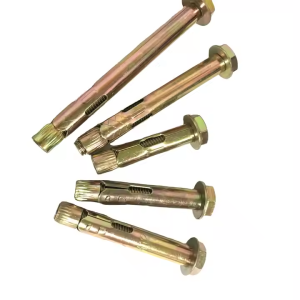
Anchor bolts for concrete are usually specified by these two numbers, whatever the expansion mechanism. The range here runs from M6 to M20 in eight diameters; the middle of the range does most of the work, and the ends are specialised.
| Diameter | Where it typically fits | Drill diameter | Note |
| M6 | Light brackets, signage, cable tray supports | 6 mm | Smallest practical size for a concrete fixing |
| M8 | General fixtures, pipe clamps, light frames | 8 mm | Common first choice for light-to-medium duty |
| M10 | Brackets, machine bases, guardrails | 10 mm | The volume size in most export orders |
| M12 | Steel columns, heavier frames, plant bases | 12 mm | Where M10 is marginal on the drawing |
| M14 | Occasional heavy fixtures | 14 mm | Non-preferred size; tooling and lead time usually worse |
| M16 | Structural connections, large plant bases | 16 mm | Heavy-duty end of the common range |
| M18 | Occasional heavy connections | 18 mm | Non-preferred size, same caveat as M14 |
| M20 | Heavy structural and civil work | 20 mm | Largest size in this documented range |
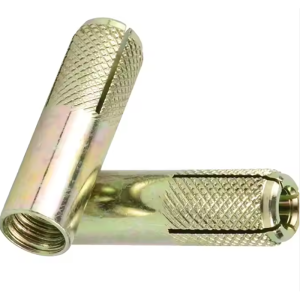
Drill diameters in the table follow the nominal size for expansion-type anchors, where the hole matches the anchor diameter. Internally threaded types such as drop-in anchors are the exception: the hole matches the insert’s outside diameter, not its thread, so the drill size is larger than the designation suggests. Confirm the pairing against the datasheet for the specific model before drilling.
M14 and M18 sit outside the preferred number series that most drawings are built on. They exist, they can be produced, and they are usually the slowest items on an order. If a design allows M12 or M16 instead, the schedule usually improves.
M22 and M24 belong to the same nominal series and appear on drawings for heavier connections, but they sit outside the range documented on this page. Treat them as a separate enquiry rather than assuming the lengths below apply.
Length: The Three-Part Calculation
Anchor bolt length is not chosen by habit. It comes out of a sum:
L ≥ fixture thickness + effective embedment + hardware allowance
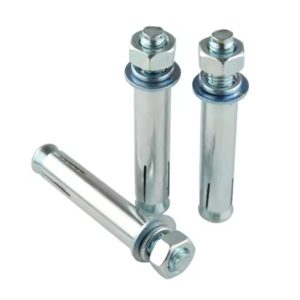
The first term you can measure. The second comes from the product’s assessment document or installation instruction for that diameter, never from a general table. The third is the washer, the nut and the projection you want above it — roughly 10–14 mm depending on diameter, plus two or three exposed threads so the nut can be fully engaged.
A worked example makes the arithmetic concrete. Take a 10 mm steel bracket, an M10 anchor, and an effective embedment of 50 mm as stated in the datasheet:
10 (fixture) + 50 (embedment) + 12 (washer, nut and projection) = 72 mm
The next length produced above 72 mm is 80 mm, so M10 × 80 is the order line. Rounding up to the next available length is normal; rounding down is not, because a short anchor loses embedment, and a lost millimetre of embedment costs more capacity than a millimetre of extra length costs money.
| Fixture thickness | Embedment (from datasheet) | Allowance | Minimum L | Order this length |
| 5 mm | 50 mm | 12 mm | 67 mm | M10 × 70 |
| 10 mm | 50 mm | 12 mm | 72 mm | M10 × 80 |
| 20 mm | 50 mm | 12 mm | 82 mm | M10 × 90 |
The 50 mm embedment figure here is an illustration only. Take the real value from the datasheet for the diameter and model you are buying; using a number from a blog post, including this one, is how anchors end up under-embedded.
The Chart: M6 to M20 and Available Lengths
The table lists the lengths produced for each diameter in this range. Every combination shown can be quoted. A combination that is not listed is not part of the standard set, though non-standard lengths can be produced where tooling and quantity allow.
| Diameter | Available lengths, L (mm) |
| M6 | 50, 60, 65, 80, 100 |
| M8 | 60, 70, 80, 90, 100, 110, 120 |
| M10 | 70, 80, 90, 95, 100, 110, 120, 130, 150 |
| M12 | 80, 90, 100, 120, 130, 150, 180, 200 |
| M14 | 100, 125, 150 |
| M16 | 100, 120, 125, 145, 150, 180, 200, 250, 300 |
| M18 | 150, 180, 200, 250, 300 |
| M20 | 150, 180, 200, 250, 300 |
Three things the table does not say, and all of them matter. It does not say how much of each length is thread, it does not say what embedment each length produces, and it does not say what each length costs to ship. The first two come from the dimensional drawing and the installation instruction for the model; the third comes from the quotation, where packing and quantity change the answer.
Where an application needs a length outside the set, raise it early. Non-standard sizes are a tooling and minimum-quantity conversation, not a catalogue lookup, and that conversation is much easier before the order than after the packing stage.
Five Ways People Misread a Size Chart
Measuring the head instead of the thread. A standard hex head on an M10 measures about 17 mm across flats, and a large-head version is wider still. Ordering by that number gets you an M16 or a returned container.
Treating the length as thread length. On a partially threaded anchor, a large part of L is unthreaded shank. A buyer who assumes 100 mm of thread will find the nut sitting on shank rather than thread once the fixture is thicker than expected.
Using the thread diameter as the drill diameter. Correct for expansion anchors, wrong for internally threaded inserts, where the hole matches the outside diameter of the insert. One drill size does not cover both families.
Assuming the same designation means the same dimensions across standards. DIN and ISO part numbers with the same nominal size can differ in head height, thread length and chamfer. When a drawing cites a standard, order to that standard, not to the size alone.
Reading the chart as stock. A production range describes what can be made and quoted. Availability, minimum quantity and lead time are separate answers, and they belong in the quotation, not in the table.
What to Write in the Enquiry
A complete line removes most of the follow-up questions:
M10 × 80, wedge anchor, carbon steel grade 8.8, white zinc, DIN, 2,000 pcs, box + carton + pallet
Six elements are doing the work: diameter and length, product family, material and grade, surface finish, standard, and quantity with packing. Add the application and the base material if you know them — a fixture on a cracked slab and the same fixture on a sound wall are not the same enquiry, even with an identical size code.

If the drawing gives only a size code and no embedment, send the drawing and the fixture thickness instead. That is enough to check whether the length on the drawing matches the calculation above, which is the single most common error in incoming enquiries.
The anchor range is listed at https://www.muyi-trading.com/products/anchor/, wedge anchor specifications at https://www.muyi-trading.com/wedge-anchor/supplier/, and the large-head expansion bolt range — the product this chart is drawn from — at https://www.muyi-trading.com/anchor-bolt/supplier/.
FAQ
Is an M10 anchor ten millimetres?
The designation is ten millimetres of nominal thread diameter. The measured outside diameter is slightly smaller, because thread tolerances are defined below nominal. That is a conforming part, not a short one.
Does the length include the head?
It depends on the product family and on the drawing convention. Some anchors are dimensioned overall, including the head; others are dimensioned from the bearing face under the nut. Always read where the dimension line starts on the datasheet drawing — ordering from an assumed convention is how an anchor arrives shorter than the fixture needs.
What drill size does an M10 anchor need?
For expansion-type anchors, a 10 mm hole. For internally threaded inserts, the hole matches the insert’s outside diameter and is larger than the thread designation. Check the installation instruction for the model rather than the size alone.
Why are M14 and M18 harder to source?
They fall outside the preferred number series that most designs use, so they are produced less often. Tooling, setup time and minimum quantities are all less favourable than for M12 or M16. Where the design permits, moving one size to a preferred diameter usually shortens the lead time.
Can I order a length that is not in the chart?
Yes, non-standard lengths can be produced. The constraint is tooling and minimum order quantity rather than capability, so it is worth raising the requirement before the order is placed rather than after.
Summary
A size code carries a thread diameter and a length, and neither one tells you the installation. Diameter sets the drill and the thread; length is a sum of fixture thickness, effective embedment and the hardware stack. This anchor bolt size chart shows which lengths exist per diameter from M6 to M20; the embedment that makes a length correct comes from the datasheet, not from the table.
Order by writing the full line — diameter, length, family, grade, finish, standard, quantity and packing — and send the drawing when the embedment is not stated. That is the shortest route from a size code to an anchor that fits.












