If you source fasteners for the European market, you have likely encountered confusion around fasteners CE certified status. Many suppliers simply state their fasteners are CE certified, and many buyers automatically assume all bolts, screws, studs and nuts carry mandatory CE marking — this is a widespread and costly misunderstanding. CE marking is not a universal certification for fasteners. It only applies when a fastener falls within the scope of specific EU harmonised regulations.
This guide is built for international purchasers, importers and quality managers. It walks you through how to identify relevant rules, review supplier compliance paperwork, distinguish different technical documents, and avoid common compliance misjudgements before you place orders.

What Is CE Marking for Fasteners, and When Does It Apply?
CE marking is a manufacturer’s declaration that a product meets applicable EU harmonised legal requirements. It is not a standalone third-party certificate, nor is it a general quality mark that all fasteners must hold.
For fasteners, the trigger for CE marking is intended end use, not the product itself.
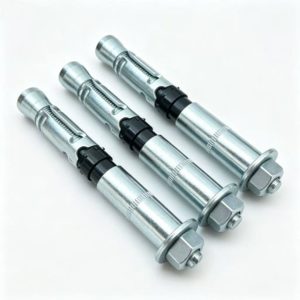
- Fasteners used for structural load-bearing construction works may require CE marking under the Construction Products Regulation (CPR).
- Fasteners supplied as components inside finished machinery usually follow the Machinery Directive rules of the whole machine, and the separate loose fastener item often does not need its own CE marking.
- General-purpose fasteners for non-load-bearing, decorative or light assembly applications are frequently outside the scope of any mandatory CE regime.
Step 1: Identify Which EU Regulation Applies to Your Fasteners
Before checking any documents, you must define the function and application of the fastener. A fastener with identical material and grade may be subject to completely different rules depending on where and how it will be used.
Key EU Regulations Potentially Relevant to Fasteners
- CPR (EU 305/2011, Construction Products Regulation): The most common framework for structural fasteners placed on the EU construction market. When a fastener is intended to permanently carry load in building or civil engineering works, harmonised European Norm (hEN) standards under CPR will set performance and assessment rules.
- Machinery Directive (2006/42/EC): Applies to complete machinery. Individual loose fasteners sold separately are normally not covered by this directive. Only the final assembled machine carries CE marking.
- Other sector rules: Specialised fasteners for pressure equipment, lifting accessories or railway systems may fall under separate regulations. These are niche cases and require separate evaluation.
If no harmonised regulation covers your fastener’s intended use, mandatory CE marking is not required.
Step 2: Understand the Difference Between Product Standards, Test Reports and Declaration of Performance / EU DoC
Suppliers often mix these three document types, and many buyers treat them as equivalent proof that fasteners are CE certified. They serve separate purposes and carry different legal weight.
Note: Declaration of Performance (DoP) is specific to the CPR regulation. An EU Declaration of Conformity (EU DoC) is used for other directives such as the Machinery Directive.
| Document | Core Purpose | Legal Status for CE |
| Harmonised standard (hEN) | Defines test methods, performance thresholds, sampling rules | Technical benchmark only. A standard on its own is not compliance proof |
| Test report | Records measured results from tested samples | Shows sample performance. Does not equal CE compliance, even from an accredited lab |
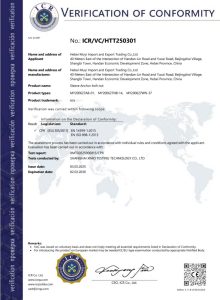
| Declaration of Performance (DoP) / EU Declaration of Conformity (EU DoC) | Formal legal statement from the manufacturer that the product satisfies regulation requirements | The core document required alongside CE marking, where the regulation applies |
A material test report showing tensile strength or hardness, for example, proves the sample meets a technical specification. It cannot replace a DoP for CPR structural fasteners.
Step 3: How to Check CE Compliance Documents From Your Supplier
Document review only makes sense after you confirm a regulation actually applies to your fastener. If CE is not mandatory, requesting a CE declaration is unnecessary.
When documents are required, verify these core points:
- Product identification: The part number, grade, size range and intended use must exactly match your purchase item. A generic document covering all fastener types is a red flag.
- Harmonised standard reference: The document must list the correct version of the applicable hEN standard. Outdated withdrawn standards invalidate the declaration.
- Declared performance characteristics: The document must clearly list the performance features being declared for the regulated use case.
- Manufacturer information: Legal manufacturer name, registered address and signatory details must be complete.
- Notified Body reference, where required: If the regulation mandates third-party assessment, the correct NB number must appear and be traceable.
Red Flags of Invalid CE Documentation for Fasteners
Watch for these frequent warning signs:
- The document is titled “CE Certificate” — the EU does not issue standalone CE certificates.
- One single declaration covers an unlimited range of unrelated fastener products.
- No intended application or performance characteristic is defined.
- Supporting test records cannot be supplied on request.
- The document confuses ISO product standards (such as ISO 898‑1) with EU harmonised standards for CE.
Step 4: Critical Fastener Information to Confirm Before Placing an Order
Lock in these details at the inquiry stage, before committing to a bulk order:
- Exact intended application: structural load-bearing, mechanical assembly, decorative use or special industrial service
- Applicable harmonised standard, if CE applies
- Mechanical property class, coating specification and size scope
- Whether a Notified Body assessment is required for this product category
- A written statement from the supplier confirming either the full compliance package, or the legal basis why CE marking is not required for this specific fastener
The same 8.8 high-strength bolt can have different compliance obligations when specified for a steel building connection versus general equipment assembly.
Common Mistakes When Assessing Fasteners CE Compliance
These errors regularly cause customs delays, rejected shipments or non-compliance risk for EU importers:
- Believing all fasteners must be CE certified.
- Accepting a mechanical test report as sufficient CE proof.
- Treating CE marking like an ISO certification scheme.
- Using one broad DoC or DoP across all fastener models and applications.
- Assuming the importer has no legal duty to validate declarations before import.
FAQ About Fasteners and CE Marking
Q: Can fasteners carry CE marking voluntarily?
A: CE marking is linked to a defined EU regulatory scope. You cannot affix CE marking to a product to claim compliance with a regulation that does not apply to it. Placing CE marking outside its relevant legal scope is non-compliant, even if done voluntarily.
Q: Is CE the same as ISO 898‑1?
A: No. ISO 898‑1 is an international standard for mechanical properties of carbon steel bolts. It is not an EU harmonised standard by default and does not equal CE compliance.
Q: Who holds responsibility for CE marking of imported fasteners?
A: The manufacturer issues the DoP or EU DoC. EU-based importers must verify documentation before releasing the product onto the EU market.
Q: What if a fastener is not covered by any harmonised standard?
A: Mandatory CE marking is not required for that product under the relevant framework. You may still request technical test documentation for internal quality control purposes.
Final Checklist for Fasteners CE Verification
Use this quick checklist for every fastener line you evaluate for EU supply:
- Confirm the intended use and decide if an EU harmonised regulation applies.
- Confirm whether CE marking is mandatory for that application.
- Cross-check that the declaration matches the exact fastener specification on your order.
- Confirm supporting test records align with the stated harmonised standard and declared performance.
- Scan for invalid-document red flags.
- File all declarations and supporting records for traceability.
Conclusion
Fasteners CE certified status cannot be judged by the presence of a CE stamp alone. The core principle is application-led compliance: the same fastener may need CE marking in structural construction, while being exempt when used for non-load-bearing assembly.
Reliable compliance depends on matching the product, its end use, the correct harmonised rules and consistent, product-specific declaration paperwork. Integrate this verification workflow into your supplier qualification and order review process to reduce customs and compliance risk for your EU-bound fastener shipments.












