Anchor Bolts for Concrete: How to Choose the Right Type
2026-11-16
A large share of anchor complaints on site turn out not to be failures of the anchor at all. They are failures of the selection that preceded it: a masonry plug used for a structural fixing, an anchor qualified only for uncracked concrete installed in a tension zone, or a product set without the installation instructions that define how it must be installed. In each case the hardware performed exactly as its documentation said it would — the documentation simply did not cover the application.
This guide sets out the order in which those decisions should be made. It is a selection guide, not a design manual. Where a number is required — a resistance, an effective embedment, a setting torque, a minimum spacing — it belongs to the product’s assessment document and installation instructions, or to the project’s designer. Nothing in this article substitutes for either.
What “Anchor Bolts for Concrete” Actually Covers
Cast-In, Post-Installed and Bonded: Three Different Load Paths
In construction usage, an anchor bolt is cast into concrete while the concrete is still workable: a headed bolt, a J-bolt, a bent rod or a threaded stud with an anchor plate. The position is fixed before the pour, and the load is carried by bearing at the head or hook together with bond along the embedded length. Nothing can be added to that connection later without cutting concrete.
Post-installed mechanical anchors are drilled in afterwards. They develop resistance by expanding against the hole wall — friction plus local bearing, and in some designs a mechanical interlock. Bonded (chemical) anchors also go into a drilled hole, but transfer load through an adhesive bond rather than through expansion.
This article deals with the middle group, because that is what most people searching for anchor bolts for concrete are actually trying to buy. Cast-in and bonded systems appear here only where the comparison helps a buyer avoid picking the wrong family.
Why Buyers Say “Anchor Bolt” but Engineers Say “Anchor”
The vocabulary is genuinely inconsistent, and it causes real ordering errors. A few common mappings are worth keeping on the desk:
What the catalogue or enquiry says
What the engineering document calls it
What it is used for
Expansion bolt, anchor bolt, fix bolt
Torque-controlled expansion anchor
Drilled fixing in concrete, set by tightening to a specified torque
Sleeve anchor
Expansion anchor with a full-length sleeve
Drilled fixing, often with a hook, eye or flange head
Drop-in anchor, female anchor
Internally threaded drop-in anchor
Flush fixing that receives a separate bolt or threaded rod
Cast-in bolt, J-bolt, L-bolt
Cast-in-place anchor
Embedded during the pour, usually for columns, plant and steel bases
Chemical anchor
Bonded anchor
Drilled fixing using an injected adhesive system
Names vary between suppliers and between regions, and the same product may be sold under three or four of them. What settles an order is not the name but the assessment reference and the installation instructions. If a supplier cannot name the document behind the product, the name on the box is of no help.
The One Question That Decides Everything: Is the Concrete Cracked?
Concrete in a tension zone is cracked, or will crack, in service. An anchor placed in that zone may sit across a crack that opens as the fixing is loaded. Products evaluated only for uncracked concrete have not been tested against that condition, and their published resistances do not describe what happens in a cracked member.
This is why the crack condition comes before any comparison of anchor types. Assessment documents state explicitly whether resistances apply to cracked and uncracked concrete, or to uncracked concrete only. Reading that line correctly removes a large share of the choices before the conversation about head shapes begins.
The Mechanical Anchor Types Buyers Ask For Most
The four families below cover most of the types of concrete anchors that buyers actually enquire about. They differ in how the expansion is generated, not in whether expansion happens.
Wedge Anchor: Torque-Controlled Expansion
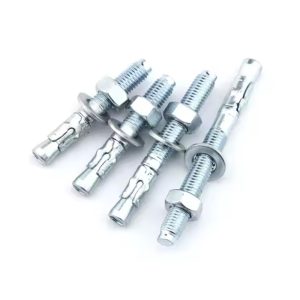
A threaded stud carries an expansion clip at its lower end, over a tapered base. Tightening the nut draws the stud outward while the clip stays where it sits at the bottom of the hole, so the tapered end is pulled through the clip and forces it outward against the hole wall. Because the setting force is applied through the torque on the nut, the specified torque is part of the installation method, not an optional refinement; an anchor that is under-torqued has not been set.
Wedge anchors set by torque: the clip expands at the base of the hole.
Wedge anchors are the usual choice where a relatively compact fixing must carry a substantial load, and where the fixture may need to be removed later even though the anchor itself stays in place. Their resistance depends on the base material, the drilled hole and correct setting — there is no universal figure that can be carried from one project to the next, which is why the assessment document, not the catalogue page, is the reference.
Sleeve Anchor and Its Variants: Hook, Eye, Flange Nut, Hex Nut
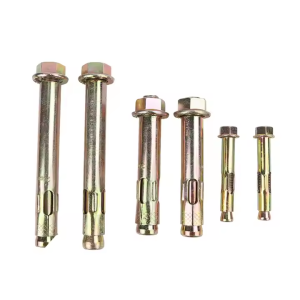
A sleeve anchor wraps the expansion mechanism in a full-length sleeve. Tightening the nut, or the bolt in a bolt-type version, draws the cone into the sleeve and splits it along its length. The result is a longer region of contact with the hole wall than a compact clip provides.
Sleeve anchors with hex nuts: the head form follows the fixture, not the load.
The variant names describe the head, and the head describes what is being fixed: a hex nut for a bracket or plant base, a flange nut for a wider bearing surface, a hook for a suspended cable or pipe, an eye for a rope or a tie, an L-hook for a rail or a frame. A hook version and a hex-nut version of the same diameter are not interchangeable in function, and the head form says nothing about the anchor’s resistance.
One boundary needs care. Sleeve anchors are frequently marketed for concrete, brick and masonry together. Those are different base materials with different failure modes, and a product qualified for concrete is not automatically qualified for hollow brick or block. The applicable base materials are stated in the assessment document; if that line is missing from the supplier’s page, ask for it before quoting the product for a masonry wall.
Drop-In Anchor: Flush, Female-Threaded
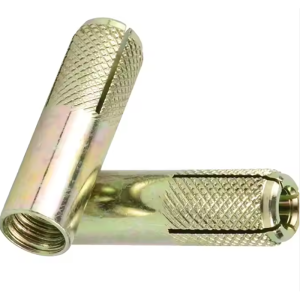
A drop-in anchor is set by driving an internal plug into the sleeve with a setting tool, which expands the sleeve against the hole wall. No torque is applied to the anchor body during setting; the fixing is then made with a separate bolt or threaded rod into the internal thread.
Drop-in anchors receive a separate bolt, so the fixing can be removed and refitted.
This makes it useful where the fixing must sit flush — suspended services, brackets that need a flat seat, and locations where the connection is assembled and taken apart repeatedly. Two installation details matter more than the type itself: the correct drill diameter, and the correct setting tool with the plug driven to the depth the instructions specify. An over-driven or under-driven plug changes how the sleeve bears on the hole.
Classification of drop-in products differs between assessment systems, so the applicable document is the place to confirm how the product is treated, rather than a generic label applied at the counter.
Bolt-Type and Heavy-Duty Variants: Three-Piece Expansion, TAM, Large-Head
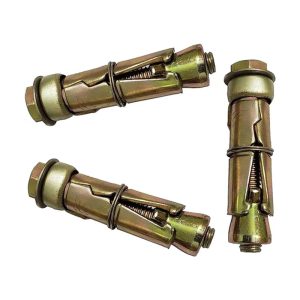
Beyond these four, buyers meet variants that change geometry rather than principle. Three-piece expansion sleeves split the expansion into three segments and spread the contact pressure more evenly. Products sold under a TAM name are heavy-duty threaded connectors, and what that name denotes varies between suppliers, so the drawing and the specification matter more than the acronym. Large-head anchors combine an oversized head with a multi-slotted sleeve, increasing the bearing area against the fixture.
Three-piece expansion sleeves spread contact pressure across three segments.
None of these introduces a new selection logic. They change how the load is distributed or how the fixture is attached; the questions about base material, crack condition and load type remain identical. What separatesheavy duty concrete anchors from the lighter end of the range is the connection they are built for, not a grade printed on the box.
Comparison Table: What Actually Separates These Types
The wedge anchor vs sleeve anchor question comes up in almost every enquiry, so it is worth answering in one place. Both are torque-controlled expansion anchors; the difference is the length over which the expansion acts and the head forms available, not the principle.
Type
How it is set
Sensitivity to setting torque
Tolerance of hole depth variation
Condition of the anchor after setting
Typical connection
Wedge anchor
Nut tightened to specified torque
High — torque is the setting method
Moderate
Set permanently; the fixture can be unbolted, but the anchor cannot be reset in the same hole
Brackets, plant bases, structural attachments
Sleeve anchor, hex or flange head
Nut or bolt tightened
High
Moderate
Set permanently in most designs; the fixture can be unbolted
General fixings, frames, pipe supports
Sleeve anchor, hook or eye
Nut or bolt tightened
High
Moderate
Set permanently in most designs; the head itself is the connection
Suspended runs, ties, railings
Drop-in anchor
Plug driven with setting tool
Not applicable at setting; depth control instead
Low to moderate
Bolt or rod is separate, so the fixing can be removed and refitted
Flush fixings, overhead services
Three-piece, TAM, large-head
Torque or dedicated setting, per product
Product-specific
Product-specific
Product-specific
Heavier connections, long projections
No capacity column appears in this table deliberately. A resistance figure is only comparable between two products when the base material, crack condition, diameter, effective embedment, installation method and assessment basis are all the same. A table that lines up numbers across types, without those conditions, is a table of incomparable values.
Base Material and Concrete Condition Change Everything
Cracked and Uncracked Concrete: What the Assessment Documents Require
Buyers often ask for a cracked concrete anchor as if it were a separate product line. It is not a separate line; it is a qualification scope, and the same product family may or may not carry it depending on the assessment.
An assessment document is not a vague endorsement. It has a scope, and that scope can be read: the product family and the diameters covered; the concrete strength range for which the resistances are valid; whether the resistances apply to cracked concrete, uncracked concrete, or both; whether static and quasi-static actions only are covered, or seismic actions as well; and any conditions on installation, such as the drilling method or the temperature range at installation.
Judging whether a given member counts as cracked is a structural question, not a product question. Useful indicators are the member type and its position in the structure, whether it sits in a tension zone, visible cracks at the fixing location, the loading stage at which the fixing is installed, and the construction sequence. Where the answer is not clear from the drawings, the practical options are to select on the more demanding assumption or to have the designer decide — not to proceed on the assumption that it will be fine.
Concrete Strength, Age and “We Don’t Know”
Published resistances are valid within a stated concrete strength range. If the actual concrete falls below that range, the numbers no longer describe the fixing, and the selection has to change or the design has to change. That is the reason a strength figure matters at the enquiry stage, not only at the calculation stage.
There are four common situations, and each has a different route:
Strength documented on drawings or in a specification — the normal case; pass the figure to the supplier and check the assessment scope covers it.
Strength undocumented but the structure is accessible — cores or other in-situ testing can close the gap, usually through the designer.
New concrete, recently poured — installation timing relative to curing matters; some products and some installation methods have requirements that a fully cured member does not.
Repaired, overlaid or heritage concrete — treat as unknown until established; patch repairs and overlays are not uniform material.
Two common base materials fall outside the scope of anchors qualified for concrete: aerated concrete, and masonry in its various forms. Both need products evaluated for those substrates. An anchor described as suitable for “concrete and masonry” should be checked line by line for which of the two it is actually qualified for.
Hole Quality: Drilling Method, Diameter and Cleaning
The anchor is only as good as the hole. Four things affect it.
Drilling method. Hammer drilling leaves a rougher wall; diamond coring leaves a smooth, accurately sized hole. For expansion anchors, the rough wall is often part of how friction develops, and some installation instructions permit diamond coring only under stated conditions or not at all. The instruction sheet, not habit, decides.
Diameter. The drill bit must match the specified diameter. A hole that is “close enough” is not close enough: an oversized hole reduces the expansion pressure available, and an undersized hole prevents the anchor from seating.
Depth. Depth must allow the anchor to sit at its specified embedment and still leave the hole clear of debris below it. In a slab of limited thickness, that constraint may rule the product out entirely.
Cleaning. Most mechanical anchor instructions require the hole to be blown, brushed and blown again before setting. A minority of products state that cleaning is not required within a defined diameter range — that exemption is valid only where the manufacturer states it for that product, and it does not travel to a different anchor.
Locating reinforcement before drilling belongs in this section too. Striking a bar damages the member and leaves a hole that cannot be used as intended.
Environment: Moisture, Corrosion, Temperature and Fire
Coating selection follows the exposure, not the price list. Electroplated zinc is appropriate for dry internal conditions; hot-dip galvanising and zinc-flake coatings are used where the fixing sees weather, industrial atmosphere or repeated wetting; stainless steel is used where chlorides are present, with the A4 (316) family the usual choice for coastal and de-icing exposure and A2 (304) for less aggressive conditions. The anchor’s own material, not only its coating, determines how it behaves at the hole wall.
Temperature is a separate axis. Mechanical anchors are limited by the steel and by the coating, and the applicable range is stated in the assessment document. Bonded anchors are more sensitive to temperature at installation and in service, which is one reason the two families are not interchangeable in cold stores or in hot plant rooms.
Fire is a third axis. A product can only be used where fire resistance is required if it has been assessed for that condition, and the resistances under fire are separate from the ambient values. An anchor that performs well at room temperature carries no fire performance by default.
Loads and Design Conditions to Confirm Before You Pick a Type
Load Type and Direction
Tension, shear, and combined tension and shear are not variations on a theme. They produce different failure modes — steel failure, pull-out, concrete cone failure, edge breakout, splitting — and the design method treats them separately, with combined loading needing a proper combination rule rather than a rule of thumb.
The conditions under which the load is applied matter just as much. Static and quasi-static actions are the baseline case. Seismic actions require a dedicated assessment; so do dynamic, fatigue and vibratory loads. A product qualified for static loading only cannot be assumed to cover a vibrating machine base, and the paperwork usually says so plainly in its scope.
Spacing, Edge Distance and Embedment: Three Interlocking Numbers
These three parameters are usually discussed together because they are physically the same problem. The resistance of an anchor depends on a volume of concrete around it. A second anchor placed close by overlaps that volume; an anchor placed near an edge truncates it; both reduce what the first anchor can carry. Change the embedment and all three relationships change with it.
Neither the spacing nor the edge distance is a rule that can be applied across products. Both come from the assessment document and from the design calculation for the actual array. A frequent field problem in this area is a dense group of fixings in a narrow upstand or close to a slab edge, discovered after the layout is fixed. Where the layout cannot satisfy the conditions, the answers are a different anchor family, a different connection detail, or a cast-in solution — not simply a longer anchor.
Which Design Basis Applies, and Who Signs Off
Two design systems dominate the English-language market. In Europe, EN 1992-4 governs the design of fastenings in concrete, with product characteristics taken from a European Technical Assessment issued under the relevant EAD. In the United States, ACI 318 Chapter 17 governs anchoring to concrete, with product characteristics taken from an evaluation report issued under the applicable acceptance criteria. Both systems do the same thing: the product document supplies characteristic resistances, and the designer applies the partial factors or strength reduction factors and checks the geometry.
The division of responsibility follows from that. A supplier provides product data and the documents that support it. The designer checks the connection and signs for it. Procurement’s task is to pass accurate inputs upstream — base material, crack condition, loads, environment, layout — and to hold the right documents on the order. A supplier who offers to “size it for you” is not thereby taking design responsibility.
Reading the Specification Sheet and the Installation Instructions
What a Usable Datasheet Must State
A datasheet that is only a dimension table is a drawing, not an anchor bolt specification. To be usable for selection it should state:
product designation, nominal diameter and length;
material and property class of the anchor body;
coating or finish, with the standard it is specified against;
base material applicability, including whether cracked concrete is covered;
the assessment reference under which the resistances are published;
installation parameters: setting torque where relevant, effective embedment, drill diameter, minimum base material thickness, minimum spacing and edge distance — each referenced to the assessment document rather than restated loosely;
units and the standard or dimensional basis used.
If any of the applicability lines is missing, the sheet can still be used to order a shape, but not to select an anchor.
Certification and Installation Instructions: Verify, Not Just Collect
A certificate number on a supplier’s page is a claim until it is checked. The verification is short:
Look the number up in the issuing body’s own listing, not in the supplier’s brochure.
Check the scope against the actual order: same product family, same diameters, same base material, same crack condition, same load type.
Check that the resistances quoted correspond to the installation method in the instructions — a value obtained under a defined setting torque does not apply to a hand-tightened anchor.
Confirm that the installation instructions will accompany the goods, in a language the installer can read, and that any dedicated setting tool is identified.
Confirm the document is current, and note its validity date on the order file.
A certificate covering a different diameter, or a different base material, is not a certificate for the item being purchased. This is one of the most frequent misunderstandings in technical procurement of anchors.
Three Red Flags in Supplier Documents
Dimensions only, no assessment reference. Nothing in the document says what the product has been evaluated for.
Values with no applicability statement. A resistance figure presented without the base material, crack condition, embedment and installation method that produced it cannot be used.
Standards claimed without identification. “Meets GB/EN/ISO” without a standard number, a report and an issuing laboratory is not a verifiable claim, and neither is “equivalent to” followed by a well-known brand.
What to Ask a Supplier Before You Order
Technical Questions, in This Order
Which base material is this product qualified for, and is cracked concrete covered?
What assessment or test document supports the resistances, and what is its reference number?
Which diameters and lengths are covered by that document?
What is the specified installation method — torque value, drill diameter, effective embedment, minimum base thickness?
Are minimum spacing and edge distance stated in the document, and can you send the relevant pages?
Are the installation instructions supplied with the goods, and in which languages?
Is a dedicated setting tool required, and is it supplied or specified?
Which head or connection forms are available in this diameter?
Which coatings are available, and what are they specified against?
Can you supply a sample and the dimensional drawing for approval before production?
Commercial and Documentation Terms
Technical suitability is only half of the order. The other half is what arrives with the goods and what can be traced afterwards: batch identification and its link to the certificate; the type of inspection document offered, for example a certificate of type 3.1 under EN 10204 as opposed to a simpler declaration; the inspection scope that document covers; packaging and marking that allow the batch to be identified on site; custom lengths and the minimum order quantity attached to them; and the realistic lead time for the quantity required.
One distinction prevents most disputes: a certificate type describes what the document attests to, not how good the product is. A type 3.1 certificate for a batch that was made to the wrong specification is still a type 3.1 certificate.
Sample, First-Article and Pre-Shipment Checks
A sample is worth more than a photograph. Check the thread form and pitch, the sleeve or clip geometry against the drawing, the marking on the body, and the coating coverage at the edges and inside the sleeve where plating is often thin. Where practical, set one anchor in a representative piece of base material using the specified tool and torque, and inspect how the expansion behaved.
Before shipment, agree a sampling basis and record what was measured: dimensions, thread gauging, coating appearance, marking, and packing count. Keep the records with the batch documents. These checks do not replace product qualification; they catch the errors that occur between a good sample and a production run.
When This Decision Belongs to an Engineer, Not a Catalogue
Some selections should not be closed at the quotation stage. The conditions below are the usual triggers:
the concrete strength or the crack condition is unknown or disputed;
the project is in a seismic area, or the fixing is subject to dynamic, fatigue or vibratory loading;
the layout cannot satisfy the spacing and edge distance conditions in the assessment document;
the connection is life-safety related, load-bearing, or part of a suspended or façade system;
fire resistance is required at the fixing;
the fixing is large diameter or deep embedment relative to the member thickness;
the base material is not the concrete the product was evaluated for.
When any of these applies, the useful move is to hand over a complete information pack rather than a question: drawings showing the fixing location and the member, the loads and their direction, the base material information available, the service environment, the fixture being attached, and the documents already collected. A designer can work from that. A supplier cannot generate it.
A Practical Selection Path
The sequence below answers the practical version of how to choose anchor bolts: the article compressed into a route. Each step closes off options rather than adding them.
Base material. Concrete, or something else? If not concrete, stop and change the product family.
Crack condition. Cracked, uncracked, or unknown. Unknown moves to the conservative assumption or to the designer.
Load type and direction. Static only, or seismic, dynamic, fatigue.
Head or connection form. What is being fixed, and does it need to be taken apart later.
Product family. Only now does the comparison of wedge, sleeve, drop-in or a heavy-duty variant become meaningful.
Four scenarios, each closed in three steps:
Application
Path
Family under review
Indoor pipe and duct supports
Concrete → uncracked, static, dry internal → flush or hex head depending on the support detail
Sleeve or drop-in
Steel base plate outdoors, coastal site
Concrete → crack condition per drawings, static plus wind → stainless or heavy galvanised → designer confirms
Wedge or heavy-duty variant
Suspended ceiling and sprinkler runs
Concrete → per drawings, static, fire exposure where required → fire assessment needed
Drop-in with a separate bolt
Lift or heavy plant bracket
Concrete → crack condition and dynamics per drawings → engineering design required
Heavy-duty expansion, or cast-in
FAQ
Are anchor bolts the same as expansion bolts?
Not in engineering usage. An anchor bolt is normally cast into concrete during the pour; an expansion bolt is installed into a drilled hole afterwards. The market uses the two terms interchangeably, which is why the assessment document, not the name, should settle an order.
Do I need an anchor qualified for cracked concrete even in a new building?
Possibly. New concrete cracks in tension zones as it takes load, so a new building is not automatically an uncracked application. The question is the position of the fixing in the structure and the loading it will see, which is a design question.
Can the same anchor be used outdoors or in wet areas?
Only if the material and coating are specified for that exposure. Electroplated zinc on a carbon steel anchor is a dry internal finish; outdoor, industrial and chloride-bearing environments call for hot-dip galvanising, zinc-flake or stainless steel, with the choice recorded on the order.
Why can’t I reuse a setting torque from a previous project?
Because the torque is part of a defined installation method for a specific product, diameter and hole condition. The value published for one anchor does not transfer to another, and under-torquing leaves an anchor that has not been set.
What is the difference between anchor length and effective embedment?
Length is the overall dimension of the item, including the thread projection. Effective embedment is the depth over which the anchor develops resistance inside the concrete. Selection uses the second; ordering usually quotes the first, which is why both should appear on the specification.
Next Step
The order of decisions matters more than the product name: base material, crack condition, load type, environment, assessment coverage, installation conditions, connection form — and only then the family. Most of the expensive mistakes happen because one of the earlier steps was skipped.
If you are preparing an enquiry, the information that makes a quotation usable is short: the base material and its condition, the loads and their direction, the service environment, the required diameters and lengths, the quantity, and the documents the project requires. With those in hand, a quotation for anchor bolts for concrete can be answered against a specification rather than against a catalogue page.