Head type decides what the anchor can hold, not how hard it pulls. Three of the four sleeve anchor head types on this site — hex, hook and L-hook — publish an identical block of diameter, length and thread form, and all four differ at the exposed end. Work the table first, then the four questions that settle which end you need.
Four Head Types, One Anchorage
The four sleeve anchor head types differ only at the connection; every one of them anchors by expanding a sleeve in the bore.
| Head type | Connection at the fixture | Grades listed on its page | Finishes listed on its page | Use named on its page |
| Hex nut | Thread face, clamped by a hex nut | 4.8, 8.8, 10.9, 12.9 | Blue white zinc, yellow zinc, natural, decolorized | General fixture fixing; the page names no specific use |
| Hook | Open throat; the attachment is laid into it | 4.8, 5.8, 6.8, 8.8, 10.9, 12.9 | The four above plus blackened and Dacromet | Home decoration, kitchen construction, door and window binding, toy and gift binding |
| Eye | Closed ring; rope, pin or shackle passes through | Not listed | Not listed | Suspension, hoisting, fixing |
| L-hook | Right-angle arm instead of a curved throat | 4.8, 5.8, 6.8, 8.8, 10.9, 12.9 | The four above plus blackened and Dacromet | Steel columns, lamp posts, heavy equipment, highway signs (page text mixes in bent anchor bolt wording) |
Two columns in that table already split the range: the hex nut version lists four grades and four finishes, while the hook and L-hook versions list six of each.
Carry those two columns into the enquiry before choosing a head. They are the ones a substitute will drop first, because diameter and length survive a substitution while grade and finish do not.
What Stays the Same Across All Four
Diameter, length and thread form are published identically across the hex, hook and L-hook versions, so the bore does not change when the head does.
Six steps run M6, M8, M10, M12, M16 and M20, with no M14 or M18. Length covers 40–280 mm on each page, thread form is coarse on each page, and the material pair reads carbon steel or stainless steel.
That block decides hole size, embedment and drill depth. None of it decides which head to fit, and none of it needs revising when the head changes.
Treat the head as an interface decision rather than a strength decision. A larger head does not add capacity that the sleeve does not have.
The four versions sit in the anchor classification, beside the wedge and drop-in types.
Put diameter and length on the drawing first, then pick the head against the attachment.
Hex: A Thread Face, Clamped From Outside
The hex family connects through a thread face, and the working choice inside it is whether the tool meets a bolt head or a nut. A flange nut version also sits in the range.
Bolt Head or Nut: Where the Wrench Goes
A bolt-head version tightens at the head, with the socket sitting on the fixture surface. A nut version tightens at the nut, with the stud end standing proud of it.
Clear space decides between them. A fixing set close to a wall, inside a corner or under an overhang may leave room for a socket at the surface but not for a wrench on a nut, or the reverse.
Three parts share the same exposed thread: fixture thickness, washer and nut. Add fixture thickness to the nut height before ordering a length, or the thread runs out before the nut reaches the fixture.
Grade and finish lists on the hex nut page read four and four. Those lists belong to that item, so the bolt-head version has to be checked on its own page or in the quotation before it is ordered.
Blackened and Dacromet appear on the hook and L-hook pages only, which means a project calling for either cannot be met from the hex nut item.
Measure the clear space around the fixing before settling on head or nut, and read the finish list on the exact version you are quoting.
Hook and L-Hook: Open Connections
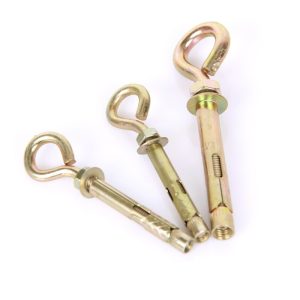
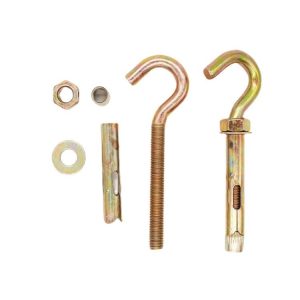
A sleeve anchor with hook connects by an open throat, so the attachment has to hang inside the opening rather than be clamped against a surface.
A curved hook closes back on itself and leaves a throat that a ring, rope or cable can be laid into. The L-hook bends at a right angle instead, presenting a straight arm rather than a closed throat, which suits a strap or a loop that slides over the arm and bears against the leg.
The two pages name different work. The hook page lists home decoration, kitchen construction, door and window binding, and toy and gift binding. The L-hook page lists structural steel columns, lamp posts, heavy equipment and highway signs, while its product-name field reads “Sleeve anchor with square hook”, a direct contradiction with the page title.
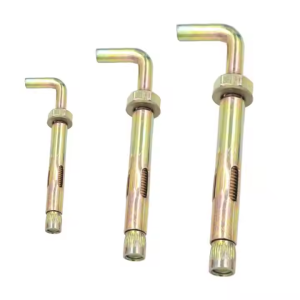
The length column on the hook page carries M6 87 mm, M8 99 mm, M10 110 mm and M12 130 mm. Both open versions publish six grades and six finishes.
An open throat can release its load when the direction reverses. Where a hung item can swing, add a keeper or move to the closed eye.
Lay the actual ring or strap against the hook drawing before ordering; the throat has to be wider than the part that goes into it.
Eye: A Closed Loop for Hanging
The eye version closes the loop, so a rope, pin, shackle or clip passes through it instead of over an opening.
A closed ring cannot unhook itself, which makes it the safer pattern wherever the load can swing or reverse. Ring plane matters as well: with the pull lying in the plane of the ring, the loop carries the load along its own axis instead of bending it sideways.
The eye page names three uses — suspension, hoisting and fixing — and stops there. Its specification block carries no grade, no finish and no size table, so nothing on that page can be ordered against.
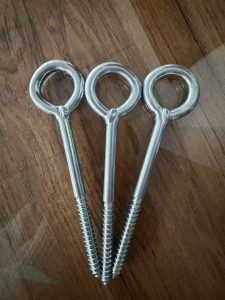
Treat that absence as the finding it is: this version has to be quoted from a drawing, not from a catalogue line. Ask for ring inner diameter, ring section thickness and shank length.
Request that drawing with the ring dimensions on it before comparing the eye version with the hook version.
Four Questions That Pick the Head
Four questions, asked in order, separate the four heads without leaving a tie.
- What is being attached? A plate with a hole takes a hex head. A ring, rope, cable or strap takes an open hook or a closed eye, and the shape of that part decides which of the two.
- Will it be taken off and put back? A thread face allows removal and refitting. Hook and eye connections are for parts that stay hung.
- Can the load reverse or vibrate? If it can, the closed eye is the safe pattern; an open hook needs a keeper, and neither should be assumed to hold against a reversing pull.
- Is the fixing exposed outdoors or near the coast? Then match the finish list of the version being bought. Four finishes on the hex nut version against six on the hook and L-hook versions means one project brief can be met by one head type and missed by another.
Stop at the first question that fires. Answering all four at once is how a mixed order reaches site with two heads that will not fit the same attachment.
Write those four answers into the enquiry beside the diameter and length, so the quotation can be checked against them.
Where Buyers Get It Wrong, and What the Pages Disagree On
Three mistakes repeat in enquiries, and the pages themselves disagree on three fields.
What the Four Pages Disagree On
| Field | Hex nut version | Hook and L-hook versions | What it costs the buyer |
| Grades | 4.8, 8.8, 10.9, 12.9 | 4.8, 5.8, 6.8, 8.8, 10.9, 12.9 | A grade read off the hook page cannot be ordered on the hex nut version |
| Finishes | Blue white zinc, yellow zinc, natural, decolorized | The same plus blackened and Dacromet | A blackened or Dacromet order placed against the hex page will not be met |
| Product name | Taula lima ma nati hex | Field reads “square hook”, title reads “L Hook” | The wrong variant gets picked straight from a search result |
Fields differ by head, and a quotation built from the wrong page produces a substitute that passes on diameter and fails on finish.
Misuse follows the same pattern. A buyer who settles the anchorage first and picks the head last ends up with a hook whose throat is narrower than the ring it was bought for. A hook fitted where the load reverses releases under the first swing. A finish taken from the hex nut page and written onto a hook order arrives in the wrong coating.
Read the grade and finish columns on the page for the exact head being bought, then sign the purchase order.
FAQ
Can I buy one sleeve anchor and change the head later?
No. Each version is supplied as a complete assembly, with the head formed onto the stud or shank at the factory. Changing the head means changing the product rather than the part, and these four pages describe four separate items.
Can a hook version be used for lifting?
Only for static hanging, and only after the throat and the attachment have been checked against each other on a drawing. This site publishes no load values for any of the four versions, so lifting duty has to be assessed from the supplier’s test data rather than from a catalogue page.
Are the eye and hook versions interchangeable?
Not freely. A closed ring lets a rope, pin or shackle pass through; an open hook needs the attachment laid into the throat. A ring wider than the throat will not go in, and a rope that can swing will not stay in without a keeper.
Is the L-hook the same product as the square hook?
The page does not settle it: the title reads L Hook while the product-name field reads square hook. Ask for the drawing and compare the bend angle before treating the two as one item.
Do all four versions come in stainless steel?
The hex, hook and L-hook pages list carbon steel and stainless steel as the material pair. The eye page lists no material field at all, so stainless has to be confirmed for that version specifically rather than assumed from the other three.
Pull the drawing for the specific head, put diameter, length and finish on it, and the four sleeve anchor head types narrow to one — an attachment that either fits the throat or does not.












