Wedge anchor torque is not a property of the diameter. It is a property of the product, the hole and the installation method, which is why two M10 anchors from two suppliers can carry two different values and both be correct. This article explains what that value represents, how to read the table your supplier provides, what under-torque and over-torque look like on site, and how to verify a setting you cannot see once it is made.
It does not reprint a universal torque table. There is no such table — any figure quoted without the product behind it is a figure waiting to fail an inspection. Where the value for a specific product is needed, it comes from that product’s own documentation, and the last section explains what to ask for.
What Torque Actually Does in a Wedge Anchor
Tightening the nut pulls the stud outward while the clip stays at the bottom of the hole. The tapered cone is drawn through the clip, the clip segments are forced outward, and the anchor grips the hole wall. Torque is the mechanism that produces that displacement; it is not a tightening force applied to the fixture.
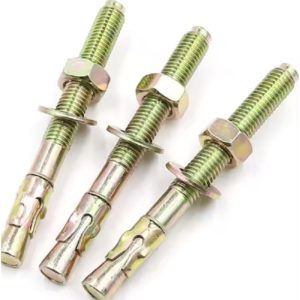
That distinction changes what you are checking. You are not confirming that the fixture is clamped. You are confirming that the expansion has been fully developed.
Why “Tight” Is Not a Setting
An under-torqued anchor can look completely normal. The nut is down, the washer is in contact, nothing moves by hand. The clip, however, may have opened only partly, and the anchor is holding a fraction of what it was designed for. The first load that discovers this is usually not a test load.
This is one of the most common failure patterns in mechanical anchoring, and it is invisible to a visual inspection. There is no gap to see and no wobble to feel.
Why More Torque Stops Helping
Once the clip is fully expanded, additional torque does not add capacity. It adds stress: to the stud, to the thread, and to the concrete around the expansion zone. Past a point, the anchor stops being an anchor and becomes a splitting wedge. Over-torque is therefore not a safety margin. It is a second failure mode.
Where the Value Comes From (and Why It Isn’t Universal)
The wedge anchor torque value is set by the manufacturer for a specific product and published in the installation instruction for that product. It is not derived from the diameter alone, and it does not transfer between brands.
Three factors move it:
- Diameter. A larger thread needs more torque to develop comparable expansion force.
- Product design. Clip length, cone angle, thread fit and coating all change how much of the applied torque reaches the expansion zone. Two products with the same thread can need different values.
- Hole condition. Hole diameter, depth and cleanliness change the friction the clip works against. A clean, correctly sized hole develops the intended expansion; an oversized or dusty hole consumes torque without producing grip.
Why Another Brand’s Value Does Not Transfer
A figure published for one supplier’s M10 describes that supplier’s clip, cone and thread. Applying it to a different M10 assumes the internals are identical, and they usually are not. The same logic applies within a brand when the finish changes: a lubricated or coated thread converts more of the applied torque into axial force than a dry, as-received thread does.
Where to Look, and What to Ask For
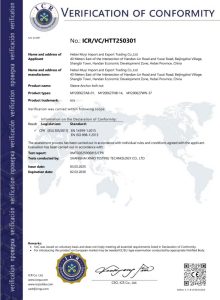
The value should come from one of three places: the installation instruction supplied with the goods, the product datasheet, or the assessment document the product is evaluated under. If none of them states a setting torque, the honest position is that no published parameter can be pointed to — and that is a question to settle before the order, not after the delivery.
Reading a Torque Value Table
A usable table is short and specific. It lists the diameters the product is made in, the setting torque for each, the unit, and the installation conditions under which the value is valid.
| What the table should show | Why it matters | Red flag |
| One row per diameter | Torque changes with thread size; a single figure for the range is not a setting value | “M6–M20: one value” |
| The value with its unit | Nm and ft-lb are different numbers for the same setting | A bare number, no unit |
| The wrench type assumed | A value set with a calibrated wrench does not describe an impact-driven installation | No mention of method |
| Drill diameter and minimum hole depth | The value is only valid in the specified hole | Torque only, no hole data |
| Effective embedment | Expansion position depends on depth | No depth information |
| Source and version | Values get revised; you need the current one | No document reference |
Wedge anchor torque values are worth checking against these six lines before they are used on a drawing, because a table missing half of them usually turns out to be a marketing summary rather than an installation instruction.
Three Checks Before You Trust a Number
Is there a unit? A torque figure without Nm or ft-lb is ambiguous, and conversions are a common source of error in mixed-unit projects.
Is it per diameter? If the table collapses six diameters into one number, it is a marketing line rather than an installation parameter.
Is there a source? A value that cannot be traced to an instruction sheet or an assessment document cannot be defended if an inspection asks where it came from.
Symptoms: Under-Torque and Over-Torque
Both failure modes leave traces, but the under-torqued anchor is the quieter of the two.
| Symptom | What it means | What you see on site | How to confirm |
| Nut keeps turning without resistance | Expansion never developed | Nut accepts further rotation after “tight” | Re-check with a calibrated wrench at the specified value; if rotation continues, replace the anchor |
| Washer not in firm contact | Anchor short of its seat | Visible gap under washer | Replace rather than re-torque: an anchor already partly set cannot be re-set in the same hole |
| Fixture moves under load | Grip developed only partly | Slight movement, then slip | A proof load by a competent party, or replacement; a slipped anchor does not re-grip |
| Stud rotates with the nut | No relative movement between cone and clip | Nut and stud turn together | Turn the nut with a wrench and watch the stud; if both rotate, replace |
| Thread damage or stretched stud | Torque applied far beyond the setting value | Deformed thread, nut binding, stud elongation | Replace the anchor and check the wrench calibration |
| Radial cracks at the fixing | Concrete loaded by the expansion, not by the fixture | Hairline cracks radiating from the hole | Stop work in that area and refer to the designer |
| Spalled or split edge | Fixing too close to an edge for the torque applied | Broken concrete at the edge | Relocate the fixing; do not simply reduce torque |
The pattern worth remembering: over-torque damage is visible immediately, under-torque damage appears later, usually under the first real load.
Verification on Site
The Wrench You Use Decides the Result
A setting torque is only meaningful if it is applied with a tool that measures it. A calibrated torque wrench, within its calibration interval, is that instrument. An impact wrench is not a substitute unless the product’s instruction explicitly permits it, because it delivers torque in pulses and gives no readable value.
Keep the calibration record with the installation record. When an anchor is questioned later, the calibration certificate is the difference between “we set it correctly” and “we believe we set it correctly”.
Sampling and Records
For each batch of settings, record enough to reconstruct the work: date, diameter, drill diameter, hole depth, applied torque, wrench identification, and the operator. Mark set anchors so a partly finished row cannot be mistaken for a completed one.
Records are not paperwork for its own sake. They are the only evidence that the expansion was developed, because the evidence itself is buried in the hole.
When No Value Is Available
If a supplier cannot state a setting torque for a product, three options are open: request the value in writing with its document reference; substitute a product whose installation parameters are published; or refer the fixing to the designer. Guessing is not a fourth option, and neither is copying a number from a different product.
What the Installation Instruction You Hand Over Should State
If you supply anchors to a project, the instruction you pass on is part of the product. It should state, for each diameter:
- The setting torque, with its unit.
- The drill diameter.
- The minimum hole depth.
- The effective embedment.
- The wrench type assumed, and whether impact driving is permitted.
- The hole cleaning sequence.
Add a diagram showing where the length is measured and what a fully set anchor looks like. Instructions that arrive in a language the installer cannot read are a common-enough cause of under-torque, and a translated one-page sheet prevents most of it.

The wedge anchor range is listed at https://www.muyi-trading.com/wedge-anchor/supplier/, the wider anchor category at https://www.muyi-trading.com/products/anchor/, and the flush-fixing alternative at https://www.muyi-trading.com/drop-in-anchor/supplier/.
FAQ
Do wedge anchors need a torque wrench?
Yes, where the product has a specified setting torque. Wedge anchor torque is the method by which the clip is expanded, not an optional refinement. An anchor tightened by feel has an unknown expansion state, and that state cannot be inspected afterwards.
Can I use a torque value published for another brand?
No. The value describes a specific clip, cone and thread combination. Applying another product’s figure assumes identical internals, and the assumption is usually wrong. Use the value in the instruction sheet for the product in your hand.
What happens if I over-torque a wedge anchor?
The clip is already fully expanded, so additional torque adds no capacity. It loads the stud, the thread and the concrete around the expansion zone, which is how edge spalling and radial cracking start. Over-torque is a failure mode, not a safety margin.
Is there one torque value for all M10 wedge anchors?
No. Diameter is one input among several. Clip design, thread condition and hole quality all shift the value, which is why it is published per product rather than per size.
What if the supplier gives no torque value at all?
Ask for it in writing with the document reference. If it cannot be provided, no published parameter can be pointed to, and that is a reason to choose a different product rather than to estimate a figure.
Summary
Torque in a wedge anchor is the mechanism that develops the expansion, so the value is a product-specific installation parameter rather than a rule of thumb attached to a diameter. Read the table for its unit, its per-diameter rows and its source; watch for the two failure modes, remembering that under-torque hides and over-torque shows; and verify with a calibrated wrench and a record you can produce later.
If the value itself is missing, no article can supply it — only the product’s documentation can. That is the one number worth insisting on before an order ships.












