Furniture fasteners are the foundational hardware components that hold every piece of furniture together, from residential cabinets and office desks to outdoor seating and custom shelving. Though often overlooked, the right fastener directly impacts structural stability, assembly efficiency, product appearance and long-term durability. For furniture manufacturers, component buyers and fastener distributors, selecting the wrong type, size or material can lead to loose joints, panel cracking, assembly delays and customer complaints.
This guide provides a complete overview of furniture fasteners, covering core definitions, common product categories, material selection logic, size matching principles and pre-procurement specification verification. It serves as a practical reference for sourcing teams responsible for selecting and qualifying fasteners for furniture assembly and hardware distribution.
1. Overview of Furniture Fasteners
1.1 Definition and Core Functions
Furniture fasteners refer to a broad range of hardware components used to join, secure, position or support furniture structures and moving parts. The category includes both standard threaded fasteners shared with general industrial applications and specialized connectors designed specifically for furniture assembly.
Compared with general industrial fasteners, furniture fasteners place extra emphasis on visual appearance, disassembly capability, material eco-friendliness and compatibility with wood-based panels. Their core functions include:
- Structural joining: Creating permanent or detachable load-bearing connections between furniture components
- Positioning and alignment: Fixing parts in precise positions to ensure consistent assembly accuracy
- Detachable assembly: Enabling flat-pack furniture to be assembled and disassembled repeatedly
- Functional support: Enabling moving parts such as doors, drawers and adjustable shelves
1.2 Basic Performance Requirements for Furniture Applications
Qualified furniture fasteners must meet a set of basic performance requirements tailored to furniture operating conditions:
- Load-bearing capacity: Sufficient tensile and shear strength to support designed static and dynamic loads
- Anti-loosening performance: Resistance to loosening under daily use vibration and repeated opening/closing
- Corrosion resistance: Ability to withstand humidity, temperature changes and occasional cleaning, especially for outdoor and bathroom furniture
- Appearance consistency: Uniform surface finish and color for exposed fasteners to maintain product aesthetics
- Repeated assembly durability: Threads and connecting structures that tolerate multiple assembly and disassembly cycles without damage
Common application scenarios include cabinet body connections, table and chair leg fixation, drawer slide installation, sofa frame fastening and door hinge mounting, each with slightly different performance priorities.
2. Common Types of Furniture Fasteners and Connectors
Furniture fasteners can be grouped into three functional categories: threaded fasteners, pre-inserted hidden connectors, and structural/functional supporting hardware.
2.1 Threaded Fasteners for Furniture Assembly
Threaded fasteners are the most widely used category in furniture production, relying on screw threads to create clamping force.
Common types include:
- Self-tapping screws (wood screws, particle board screws): Designed to form their own threads when driven into wood, particle board or medium-density fiberboard (MDF). They are the primary choice for panel-to-frame connections, back panel fixation and internal structural assembly.
- Machine screws with nuts: Used for through-hole connections where both sides are accessible. They provide higher clamping force and better reusability than self-tapping screws, making them ideal for frequently disassembled furniture and metal frame structures.
- Flange screws: Feature an integrated washer flange under the head to distribute load and prevent sinking into soft panel materials.
- Domed cap nuts: Used on exposed thread ends to cover sharp edges and improve visual appearance, commonly seen on metal frame furniture and display racks.
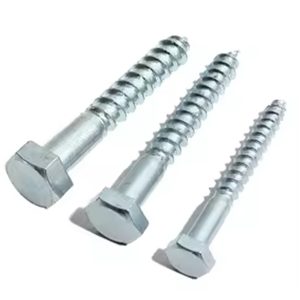
Our industrial hex nut range includes options suitable for general furniture assembly applications.
2.2 Pre-inserted and Hidden Connectors
Hidden connectors are designed to create invisible joints for a clean, seamless furniture appearance, especially popular in flat-pack panel furniture.
Common types include:
- Three-in-one connectors (cam lock system): Consist of an eccentric cam, pre-inserted nut and connecting rod. They create strong, invisible right-angle joints between panels and are the standard hardware for ready-to-assemble (RTA) cabinets and wardrobes.
- Threaded insert nuts (insert nuts): Pre-installed into panel edges to receive machine screws. They provide strong, reusable threaded connections in particle board and MDF where self-tapping screws would have poor holding power.
- Wood dowels: Cylindrical wooden pins used for alignment and supplementary reinforcement in solid wood and panel furniture joints, usually used with adhesive.
- Expansion nuts: Inserted into pre-drilled holes and expand when tightened, providing strong pull-out resistance in hollow or thin panel materials.
2.3 Structural and Functional Supporting Hardware
These hardware components typically work in combination with basic threaded fasteners to deliver full furniture functionality.
Common types include:
- Corner brackets and L-brackets: Reinforce right-angle joints between panels, adding extra shear and tensile strength to cabinet corners and shelf supports.
- Hinges: Enable door opening and closing motion, available in various styles including concealed hinges, butt hinges and soft-close hinges.
- Drawer slides and runners: Support smooth drawer movement, with options for side-mount, under-mount and full-extension designs.
- Shelf supports and pins: Position and hold adjustable shelves inside cabinets and bookcases.
3. Material and Joint Structure Selection Considerations
Selecting the right material and matching the fastener to the joint type are critical to joint performance and service life.
3.1 Common Materials and Application Scenarios
Furniture fasteners are made from four primary materials, each with distinct advantages and best-use scenarios:
- Carbon steel (zinc-plated/black oxide): The most cost-effective option with good strength. Zinc-plated carbon steel offers basic corrosion resistance for indoor dry environments. It is widely used for internal structural connections where appearance is not a priority.
- Stainless steel (grade 304/316): Provides excellent corrosion resistance and good strength. Grade 304 is suitable for bathroom and kitchen furniture, while grade 316 is recommended for outdoor coastal furniture exposed to salt air.
- Zinc alloy: Typically die-cast into precision shapes such as cam locks and insert nuts. It offers good dimensional accuracy, moderate strength and a smooth finish, making it ideal for hidden connecting hardware.
- Aluminum alloy: Lightweight with good corrosion resistance, commonly used for lightweight furniture frames, decorative fasteners and extrusion-based furniture systems.
Material selection should balance strength requirements, environmental conditions, appearance needs and budget constraints.
3.2 Matching Fasteners to Furniture Joint Types
Different joint designs and base materials require different fastener solutions.
By joint function:
- Permanent fixed joints: For joints not intended for disassembly, use self-tapping screws, corner brackets with screws, or dowels with adhesive.
- Detachable joints: For flat-pack and modular furniture, use machine screws with insert nuts, three-in-one cam connectors or bolt-and-nut combinations.
- Moving/active joints: For doors, drawers and adjustable parts, use hinges, slides and pivot hardware matched to load and travel requirements.
By base material:
- Particle board / MDF: Use coarse-thread self-tapping screws or insert nuts for better holding power; avoid fine-thread fasteners which may strip easily.
- Solid wood: Use wood screws or dowel joints; pilot holes are recommended to prevent splitting.
- Metal tube frames: Use machine screws with nuts or weld nuts for strong, reusable connections.
Note: Optimal pilot hole diameter and thread engagement depth vary by panel density and material. These parameters should be verified with material suppliers or testing data before mass production.
4. Size, Installation and Compatibility Requirements
Even the correct type of fastener will fail if sized incorrectly, installed improperly or mismatched with accessories.
4.1 Size Selection Principles and Thread Matching
Correct sizing ensures sufficient holding strength without damaging furniture panels.
Key sizing principles:
- Diameter and pilot hole match: The screw diameter must be matched to the pilot hole size. A hole too small causes panel splitting; a hole too large reduces holding power.
- Engagement depth: The threaded portion must engage the base material by a minimum depth, typically 2–3 times the screw diameter for wood-based panels.
- Overall length: The fastener must be long enough to achieve full engagement but not so long that it penetrates through the visible face of the panel.
- Thread form compatibility: Machine screws must match the thread pitch and diameter of the corresponding nut or insert. Mismatched threads cause cross-threading and stripping.
For instance, using an M4 self-tapping screw in an oversized pilot hole will drastically reduce holding power and lead to premature joint loosening. Common sizing errors include using screws that are too short for adequate grip, or too long and protruding through finished surfaces.
4.2 Installation Methods and Tool Requirements
Different fasteners require different installation methods and tools:
- Self-tapping screws and machine screws: Installed with manual or electric screwdrivers; torque control is recommended to avoid over-tightening and stripping.
- Three-in-one connectors: Require precision pre-drilling with dedicated drill bits and jigs for correct alignment.
- Insert nuts and expansion nuts: Typically pressed or tapped into pre-drilled holes; some types require a hammer or insertion tool.
- Weld nuts and brackets: Welded to metal frames, requiring welding equipment and skilled labor.
Common installation defects include stripped threads, misaligned holes, panel splitting and fastener head damage.
4.3 Matching Accessories and Compatibility Risks
Fasteners often require matching accessories to perform reliably.
Common accessories:
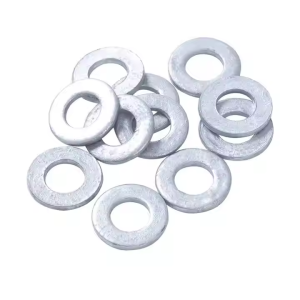
- Flat washers: Distribute clamping load and prevent fastener heads from sinking into soft materials.
- Spring washers and lock washers: Provide anti-loosening force for joints subject to vibration, such as chair legs and movable furniture.
- Plastic caps and covers: Hide exposed fastener heads for improved appearance.
Browse our full selection of flat washers and spring washers for fastening support.
Key compatibility risks:
- Galvanic corrosion: When dissimilar metals (such as aluminum frames and stainless steel screws) are in contact in humid environments, corrosion can accelerate. Isolation washers are recommended in such cases.
- Environmental compliance: Surface treatments and materials must meet applicable regulatory requirements such as RoHS for restricted hazardous substances.
5. Pre-Procurement Specification Verification Checklist
Clear specification and verification before ordering prevents delivery mismatches and production delays.
5.1 Core Specification Verification Items
When placing orders, always define the full specification rather than relying on general descriptions. A complete furniture fastener specification includes:
- Material grade and surface finish (e.g., carbon steel, blue-white zinc plated)
- Fastener type and head style (e.g., pan head self-tapping screw)
- Thread diameter and pitch (e.g., M4, 1.4mm pitch coarse thread)
- Overall length and grip length
- Strength grade or performance class
- Packaging requirements and quantity per pack
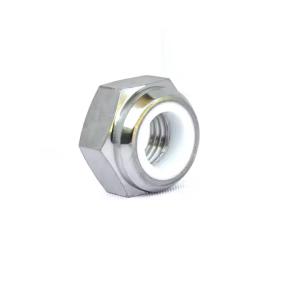
Example of a complete purchase specification: Pan head Phillips drive self-tapping screw, M4 × 16 mm, carbon steel with blue-white zinc plating, 1000 pieces per carton.
5.2 Practical Sourcing Risk Mitigation Tips
To reduce quality and specification risks when sourcing furniture fasteners:
- Request sample fasteners for trial assembly on actual production panels before placing bulk orders
- Require material test reports and compliance certificates for critical environmental requirements
- Conduct incoming inspection on key dimensions, thread quality and surface finish for each batch
- Verify thread compatibility with matching nuts, inserts or base materials through fit testing
- Clarify packaging and labeling requirements to avoid sorting errors on the production line
6. Key Takeaways for Furniture Fastener Sourcing
Furniture fasteners are highly application-specific components where small specification differences have a large impact on final product quality. For sourcing and engineering teams, the core takeaways are:
- Furniture fasteners include threaded fasteners, hidden connectors and supporting hardware, each serving different functional purposes.
- Material selection must match the operating environment, strength requirements and aesthetic expectations of the finished furniture.
- Fastener type must be matched to joint function (fixed, detachable or moving) and the base panel material.
- Correct sizing, proper installation tools and matching accessories are essential to avoid assembly defects and joint failure.
- Always verify full specifications and conduct trial assembly before committing to bulk procurement.
By following a structured selection and verification process, furniture manufacturers and distributors can improve assembly quality, reduce defect rates and extend product service life.Explore our complete industrial fastener catalog for more hardware options.












