Concrete anchor bolt coating decides how a fixing fails, not whether it fails: the steel is the same across finishes, the zinc layer is not. Three systems cover most orders — electroplated zinc, hot-dip galvanizing, and zinc-flake coatings sold as Ruspert or Dacromet. Read them as three film thicknesses with three thread consequences, then write the system, the thickness basis and the thread allowance into the order.
What a Coating Has to Do on an Anchor Bolt
A zinc coating protects the bolt in two ways and constrains it in a third. The barrier comes first: zinc keeps water and chloride off the steel, so there is nothing for corrosion to attack. Where that barrier breaks, the sacrificial effect takes over — zinc is anodic to steel (zinc corrodes first, steel stays intact).
Once the film is thick enough to matter mechanically, the coating stops being a surface treatment and becomes a fit problem — the third job, and the one most orders leave out.
Judge a system at a cut end and a spanner flat on a sample, not on how even the color looks: even color is process control, behavior at a scratch is protection. Before comparing finishes, decide which of those three jobs the fixing depends on — where only the first two matter, a thin film is enough and the thread stays simple.
Coating Is Part of the Corrosion Allowance
Adding thickness later is not a finishing decision. A bolt and nut designed around a thin film will not accept a heavy one without a thread change, which is how “the nuts won’t go on” becomes a shipment dispute. Thickness belongs in the quotation, not in the dispatch note.
Electroplated Zinc: The Default, and Its Limits
Electroplated zinc is the default concrete anchor bolt coating because it is thin enough to leave the thread alone. Deposited electrolytically, the film typically measures in micrometers rather than tenths of a millimeter, so thread fit is unchanged and no oversize allowance is needed.
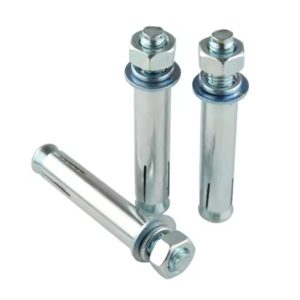
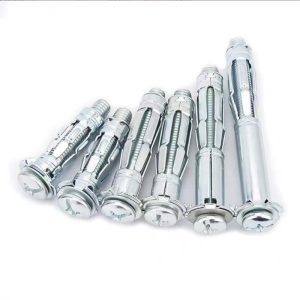
Blue-white and yellow are the two appearances buyers recognize on concrete anchor bolts. On this range the anchor bolt specification table lists blue and white zinc and yellow zinc, and alongside them blackened, Dacromet and hot-dip galvanized (HDG) — the finish field on that page is a menu, not a default.
Three things decide whether the default holds. A thin film has little zinc to give, so protection after a breach rests on the sacrificial action of the area around it. Breaches come from the installation itself: a spanner, a cut end, a scratched thread, a damaged carton. Dry, embedded service absorbs all of them; above grade in a chloride-bearing or industrial atmosphere, none is forgiven.
Confirm the exposure before accepting the plated default, and ask for the finish field rather than a color description.
Hot-Dip Galvanizing: Thickness and the Thread Problem
A hot dip galvanized anchor bolt buys thickness at the cost of the thread. The bolt is immersed in molten zinc and a zinc-iron layer forms by reaction with the steel, bonded rather than deposited, which is why it tolerates handling that would strip a plated bolt.
Thickness is not a fixed number: it grows with the steel section and it is set by the standard the order is placed against. Three standard numbers appear on fastener orders and they are not interchangeable — ISO 1461 (galvanized steel articles in general), ASTM A153 (zinc coating on hardware), ASTM F2329 (hot-dip coating on bolts, screws, nuts and washers). Each carries its own inspection scope, so swapping one for another is quoting different work.
The thread is where thickness shows up as a problem. Coating adds material to the thread flanks, so the nut that fitted the bare bolt will typically not run down the coated one. Three routes solve it, and each has to be stated: the thread is cut oversize before coating, the nut is tapped oversize, or the thread is chased after galvanizing.
One condition belongs on the enquiry before a price comes back: galvanizing is a high-temperature process applied to the finished bolt, so the grade has to tolerate it. Whether a specific high-strength grade is suitable is a supplier question, not something to assume from the property class.
An order that says “galvanized” without naming which of the three standards leaves the inspection criteria undefined — treat it as unspecified until a number is on paper. Put that number, and one of the three thread routes, into the enquiry, then compare quotations on that basis.
Zinc-Flake Coatings: Ruspert, Dacromet and Their Relatives
Zinc-flake coatings exist because they separate protection from thread fit. Zinc or zinc-alloy flakes (zinc dust in a cured binder) are applied by dip-spin or spray and cured into a dense film, usually with a top coat over it.
Ruspert and Dacromet are trade names for systems of this type, not names for a single chemistry. Protection comes closer to galvanizing than to plating, delivered in a film thin enough that the thread still fits without an oversize cut. That combination is why these systems appear where a plated bolt rusts too early but a galvanized thread is a nuisance.
A trade name is not a specification: grade, coat count, curing and test basis set the protection, and the name sets none of them. The film also resists abrasion better than plating but not careless handling, so a bolt dragged across a truck bed still loses protection where it rubs.
Availability matters as much as chemistry on these systems. This range’s anchor bolt specification table lists Dacromet and HDG, and does not list Ruspert — so a Ruspert request has to be confirmed against the specific item rather than read off the range.
A quotation that offers a trade name without a grade, a coat count and a test basis is selling a word, and the word will not survive a warranty claim.
Ask for the system grade, the number of coats and the test basis, then confirm that the item you are ordering is available in it.
Where the Coating Usually Fails
Most coating failures on site are handling failures rather than chemistry failures. Five patterns account for most of the complaints that reach suppliers:
- Cut ends. A bolt cut after coating has bare steel at the cut; the end becomes a known weak point unless the cut happens first.
- Spanner damage. The installation removes coating exactly where the load runs, and no system is specified for that.
- Unchased threads after galvanizing. Zinc left in the thread bore stops the nut part-way down and gets blamed on the coating rather than the process.
- Dissimilar metal contact. Galvanized or zinc-flake bolts held against stainless components in a wet joint form a corrosion cell neither coating was designed for.
- No incoming inspection. A finish called galvanized on the packing list, with no thickness check on receipt, is a finish nobody verified.
Two checks sort most of these quickly. If the nut stops part-way down, inspect the thread for unchased zinc before blaming the system. If rust appears first at a cut end or a spanner flat, the handling was the problem, not the specification.
Run the five patterns against the last delivery that caused trouble; most cases resolve to one of them, and the corrective action usually sits in the order rather than in the chemistry.
Matching a Concrete Anchor Bolt Coating to the Exposure
Exposure decides it, and ranking the three systems is the wrong exercise. The useful comparison runs from the service condition to the coating that commonly survives it.
| Exposure | What commonly holds up | What to settle before ordering |
| Dry interior, embedded in concrete | Electroplated zinc | Handling damage only |
| Sheltered exterior, inland | Electroplated zinc or zinc-flake | Whether the film meets the service life the project specifies |
| Coastal, industrial, or regularly wet | HDG or a zinc-flake system | The thickness class or system grade, and the thread allowance |
| Coastal with a visible finish requirement | Zinc-flake with a top coat | Color and gloss consistency across batches |
| Bolts cut to length on site | HDG or zinc-flake, cut before coating | Whether the cut happens before or after coating |
Find the row that matches the fixing, then answer the third-column question before the order is confirmed. A row you cannot answer is a specification you have not finished writing.
What to Put in the Order
Five items turn “coated” into a specification.
- The system, by name and grade, not by color.
- The thickness basis — the standard number, or the thickness class where the system has one.
- The thread allowance — oversize thread, oversize nut, or post-coating chase.
- The cut instruction — before coating or after.
- The inspection basis — what will be measured on receipt, and by which method.
The systems differ mainly in where they sit on film thickness, and that drives both protection and thread consequence: plating for dry and embedded work, galvanizing for exposed coastal and industrial service once a thread allowance is agreed, zinc-flake for near-galvanizing protection in a film that still fits a standard thread.
What stays constant is the paperwork — a system named by grade, a thickness basis, a thread route, a cut instruction and an inspection method. A concrete anchor bolt coating described only by its color is not a specification.
Put those five lines in the enquiry. Quotations written against them come back comparable, and the coating question stops being a surprise at goods in. The rest of the range sits in the anchor category.
FAQ
Which coating is best for concrete anchor bolts?
No system is best in the abstract. Dry, embedded work is served by electroplated zinc; coastal, industrial and permanently wet work needs hot-dip galvanizing or a zinc-flake system. Specifying the heaviest option by default adds cost and creates a thread problem that then has to be solved.
Is a hot dip galvanized anchor bolt better than a zinc plated one?
It is thicker and survives handling that would strip a plated bolt, which is why it is used outdoors. It also changes the thread, so the bolt needs an oversize thread or an oversize nut. The advantage only holds when that allowance was specified in the first place.
What is Ruspert coating?
A zinc-flake system sold under that name: zinc flakes in a binder, applied as a thin film and usually finished with a top coat. On this range the anchor bolt specification table lists Dacromet rather than Ruspert, so availability has to be confirmed per item instead of assumed from the product family.
Can I use a galvanized bolt with a standard nut?
Not usually. Galvanizing adds material to the thread flanks, so a standard nut runs down part of the way and stops. Either the nut is tapped oversize or the bolt thread is cut oversize before coating, and the choice should be written on the order.
Does the coating affect how the anchor holds in concrete?
The expansion mechanism is unchanged, and the film is thin next to the tolerance on a drilled hole, so the hole size does not change. Thread fit is the part that needs confirming: with HDG, ask whether the nut or the thread is supplied oversize, and whether any other dimension changes on the coated version.












