The choice between these two fixings is not a matter of strength; it is a matter of what the hole has to look like afterwards and whether anything will be taken apart later. The drop in anchor vs wedge anchor question is settled by base material, the finish that has to pass over the fixing, and the depth available — not by a headline load figure that has to be checked against a data sheet anyway.
The four conditions below settle it in sequence, and none of them requires a guess.
One Is an Insert, One Is a Stud
A drop-in anchor is an insert; a wedge anchor is a stud. The drop-in is a short sleeve with a female thread (an insert you screw a bolt into) that sits flush once it is set, while the wedge is a single rod with an expansion clip at the bottom and a nut at the top.
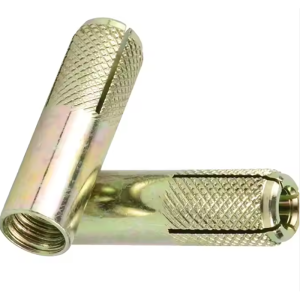
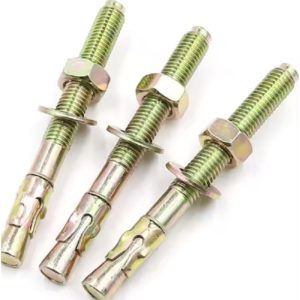
Structure decides everything downstream: with one, the fastener is a separate purchase; with the other, the fastener is the anchor.
The two ranges on this site are listed in the same diameter steps — M6, M8, M10, M12, M16 and M20, with no M14 or M18 — but only the wedge carries a length field, 40–280 mm. A drop-in has no length to choose because the sleeve depth is fixed.
Check that diameter list before comparing prices: a missing M14 or M18 in a quotation is not a gap, it is the range.
How Each Transfers Load into Concrete
Both fixings bite by expanding a sleeve against the drilled wall, so neither depends on a chemical bond. What differs is the length of the load path between the load and the concrete.
A drop-in transfers through two interfaces: the bolt thread into the sleeve, then the sleeve pressed against the hole wall. A wedge transfers through three: the nut onto the stud, the stud pulling the wedge block, and the clip pressed against the wall.
Every interface is somewhere clearance or slip can appear, and the shorter path has fewer of them. That is an argument about sensitivity, not about capacity.
Count the interfaces before arguing about strength, then identify which part carries the load. If the bolt carries it, you are specifying a drop-in.
Flush Fit: What the Drop-in Actually Buys You
A drop-in buys two things — a flush hole mouth and a removable fastener — and it pays for both in thread engagement.
The flush mouth is what lets a fixing pass under tile, render or a waterproofing layer without the head sitting proud of the surface. The removable fastener is what lets a bracket be taken down, or a bolt of a different length be fitted into the same sleeve.
The payment is in engagement. A rule of thumb for threaded fasteners is that engagement should at least match the bolt diameter; below that, the first few threads take most of the load and the joint fails at the thread rather than at the concrete.
The second payment is drilling. The sleeve has to reach its set depth, or the flush result disappears and the insert stands proud.
Where the engaged length cannot be guaranteed on site, the flush benefit is not worth the risk.
Measure the engaged length on the first fixing of each size, before the rest of the batch goes in.
Load Capacity: The Difference Is Not the Type
Load capacity does not follow the anchor type; it follows diameter, effective embedment and base material. Both fixings sit under the same three constraints, so a comparison that moves any one of them is not a comparison of the two products.
Neither published table for these two products carries a load or pull-out column. The number has to come from a data sheet or a site test, and a figure quoted without diameter, embedment and base strength attached cannot be used for a decision.
Each type has its own weak link, and neither weak link is the expansion mechanism. For the drop-in it is thread engagement, because the sleeve only holds what the bolt screws into. For the wedge it is the exposed stud, which is what corrosion, impact and accidental bending act on for the life of the fixing.
Compare only at equal diameter, equal effective embedment and equal base strength. Anything else is three variables moving at once, and it will produce a conclusion that does not survive the next project.
Ask for load data with those three conditions attached, or plan a pull test on the first fixings.
Six Points That Separate a Drop-in from a Wedge Anchor
Six rows settle the drop in anchor vs wedge anchor question, and none of them is load capacity.
| Point | Drop-in anchor | Wedge anchor |
| Connection | Female thread in the sleeve; bolt bought separately | Male thread on the stud; nut supplied with it |
| Relation to the surface | Flush with the hole mouth; passes under finishes | Stands proud; the stud length has to be planned |
| Removability | Bolt can be removed and replaced | Removal means cutting the stud; the hole is lost |
| Base thickness demand | Set by the sleeve depth | Set by effective embedment of the stud |
| Exposure after installation | Only the hole mouth is exposed | The whole stud is exposed |
| Surface finish options on this range | Blue white zinc, yellow zinc, natural color, decolorized | The same, plus blackened and Dacromet |
Rows two, three and five usually decide the case before any load figure is needed.
Mark the rows you cannot answer; the unanswered one is the question to put to your supplier.
Four Conditions That Pick One
Four questions, answered in order, pick one of the two without a tie.
- Is the base thick enough for the fixing? If the base is thinner than the sleeve depth or the stud embedment, neither type applies. Ask for that diameter’s embedment figure, then compare it with the measured base thickness.
- Does anything have to pass over the hole? Tile, render, insulation or a membrane that cannot be cut means a flush mouth, which means the drop-in.
- Will it be dismantled later? A bracket, a machine frame or a temporary support that comes down rules out the wedge, because removal cuts the stud.
- Is the fixing near a free edge, or is the load pulling outward? Both types load the concrete by expansion pressure, so a small edge distance is a reason to change the layout or the fixing, not a reason to choose by preference.
Stop at the first question that fires. Answering all four at once is how mixed orders and mixed installations happen.
Write those four answers into the enquiry, so the quotation can be checked against them rather than against a product name. Other anchor types are listed in the anchor product range.
Where Each Gets Misapplied
Four misapplications account for most of the failures seen with these two fixings.
- Drop-in in a thin base or a hollow block. The sleeve has nothing to bear against, so tightening the bolt produces spin rather than a set anchor.
- Drop-in with too little engagement. The bolt screws in shallow, the load sits on the first threads, and the joint strips before the concrete is tested.
- Wedge close to a free edge. Expansion pressure splits the edge, and the anchor looks loose in a hole that has grown.
- Wedge where dismantling was always going to happen. Removal means cutting the stud, and the hole cannot be reused at the same size.
A drop-in that spins is telling you the sleeve is not bearing on the wall, not that the anchor is weak. Spalling at a free edge is telling you the expansion was too close to it.
Match the symptom to the cause before changing products. Three of the four are decided before a drill is picked up; only the short engagement happens at installation.
FAQ
Is a drop-in anchor weaker than a wedge anchor?
Not by type. Capacity follows diameter, effective embedment and base strength, and both fixings sit under the same three limits. The drop-in’s real constraint is how much bolt thread engages the sleeve. Set the two side by side at the same diameter and embedment, and the difference comes from the interfaces, not from the label.
Can I use a wedge anchor in a hollow block?
No. Expansion needs a wall that can resist being pressed outward, and a hollow block has none. The clip opens into a void and the anchor pulls out under load. A drop-in fails there for the same reason. Both need solid concrete or dense natural stone.
Why does my drop-in anchor spin when I tighten the bolt?
The sleeve is not bearing on the hole wall. Either the hole is oversized, the hole is too deep and the sleeve sits below its set depth, or the base is too soft or too thin to resist the expansion. Check hole diameter and depth before blaming the anchor.
Do I need a special drill bit for either type?
Neither product needs a brand-specific bit. Both are set by expansion into a drilled hole, so what matters is the hole diameter and depth listed for that product, drilled with a masonry bit suited to concrete. A bit that is oversized, worn or wrongly sized produces the spin and pull-out described above.
Which one should I use for a ceiling hanger?
A ceiling hanger is usually dismantled or adjusted, and its hole is often in a soffit that will be finished afterwards. That points to the drop-in: flush mouth, replaceable bolt, and the hanger rod chosen separately. Check the slab thickness against the sleeve depth first.
The drop in anchor vs wedge anchor decision comes down to those four questions rather than to whichever specification table reads better. Send the base thickness, the build-up over the hole and whether anything will be dismantled, and the right one can be quoted without a guess.












