Introduction
Hex nuts are widely used in industrial machinery, construction, equipment assembly, steel structures, and general mechanical applications. Their six-sided shape allows them to be tightened with standard wrenches, while their internal threads engage with compatible bolts and threaded rods to secure components.
However, selecting the right hex nut involves more than matching its nominal diameter to a bolt. Different nut designs have different dimensions, structural features, and mechanical requirements. Thread pitch, tolerance, material, property class, and surface finish also affect whether a nut is suitable for a particular bolted connection.
For industrial buyers, fastener distributors, and engineers, understanding these differences helps prevent thread mismatches, unsuitable material combinations, and procurement errors.
This guide explains common types of hex nuts, how to identify their specifications, how to check bolt compatibility, and what to consider when purchasing and inspecting them.
1. What Are Hex Nuts and How Do They Work?
A hex nut is a threaded fastener with a six-sided external body and an internally threaded hole. It is commonly used with a compatible bolt or threaded rod to secure two or more components together.
The hexagonal exterior provides flat surfaces for wrench engagement, while the internal threads allow the nut to move along the external threads of a mating fastener.
1.1 Basic Structure of a Hex Nut
Most conventional hex nuts share several basic structural features:
- Hexagonal body: The six-sided exterior provides flat surfaces for tightening and loosening.
- Internal threads: The threaded hole engages with the external threads of a compatible bolt or threaded rod.
- Bearing surface: The underside of the nut contacts the supporting component or washer.
- Chamfered edges: Many hex nuts have beveled edges around the upper surface to facilitate handling and provide a finished appearance.
Several dimensions are important when identifying a hex nut:
| Dimension | Fa'amatalaga |
| Nominal thread diameter | Designated diameter of the internal thread |
| Width across flats | Distance between two opposite flat surfaces |
| Nut height | Overall axial thickness of the nut |
| Thread pitch | Distance between adjacent thread crests |
| Thread tolerance | Permitted variation affecting internal and external thread fit |
These dimensions help buyers identify the correct product and check whether it meets the requirements of a particular assembly.
1.2 How Hex Nuts Secure Bolted Connections
A hex nut engages with the external threads of a bolt or threaded rod. When tightened, the nut moves along the thread and generates clamping force within the assembled joint.
A typical bolted connection involves the following steps:
- A bolt passes through aligned holes in the components.
- A washer may be placed against the supporting surface when required by the joint design.
- A compatible hex nut is threaded onto the bolt.
- The nut is tightened according to the specified assembly procedure.
The resulting clamping force helps hold the connected components together.
Connection reliability depends on thread compatibility, fastener mechanical properties, joint design, installation conditions, and the specified tightening procedure.
A correctly selected hex nut is therefore an essential part of the complete bolted assembly.
2. Common Types of Hex Nuts and Their Differences
Hex nuts are available in different designs to meet various fastening requirements. Their classification can be based on body dimensions, structural features, or locking functions.
These categories are not necessarily mutually exclusive. For example, a hex flange nut describes a bearing-surface design, while a lock nut describes a functional feature intended to resist loosening.
2.1 Standard Hex Nuts
Standard hex nuts have a conventional six-sided body and internal threads. They are among the most widely used nuts in industrial fastening.
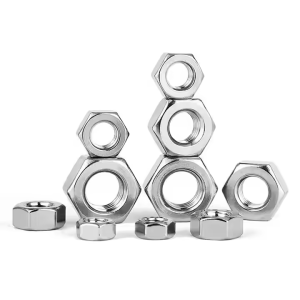
Common applications include:
- Machinery and equipment assembly
- Metal fabrication
- Construction projects
- General industrial maintenance
- Connections involving compatible bolts and threaded rods
Standard hex nuts are available in different thread sizes, materials, property classes, and surface finishes.
When selecting them, buyers should confirm the applicable dimensional standard and verify compatibility with the mating bolt.
2.2 Heavy Hex Nuts
Heavy hex nuts have a larger and heavier geometry than corresponding regular hex nuts under applicable product specifications.
Their width across flats and nut height differ from those of conventional hex nuts.
They are commonly specified for structural and other demanding bolted assemblies where the engineering requirements call for this nut design.
However, a heavy hex nut should not automatically be considered stronger or suitable for every high-load application. Its mechanical properties depend on the specified material, manufacturing requirements, dimensions, and applicable standard.
Buyers should check both dimensional and mechanical requirements rather than selecting heavy hex nuts based on appearance alone.
2.3 Thin Hex Nuts and Jam Nuts
Thin hex nuts have a reduced height compared with regular or high hex nuts of the corresponding nominal thread size.
A thin nut may be used as a jam nut in a locking arrangement, where it is assembled together with a regular or high nut.
This arrangement uses two nuts tightened against each other to help resist loosening.
Important considerations include:
- The height and design of both nuts
- The required thread engagement
- The tightening sequence
- The mechanical requirements of the assembly
Thin hex nuts should not be treated as direct replacements for regular nuts in load-bearing applications without engineering verification.
ISO 4035 identifies thin hex nuts as style 0 and explicitly warns that their loadability is reduced compared with regular or high nuts. They are not designed to provide resistance to thread stripping.
2.4 Hex Flange Nuts
Hex flange nuts feature an integrated flange beneath the hexagonal body.
The flange provides a larger bearing surface than a conventional hex nut without an integrated flange. Depending on the design, serrations may also be incorporated to help resist loosening.
Typical applications include:
- Machinery assembly
- Automotive components
- Equipment installation
- Sheet metal fastening
When selecting flange nuts, buyers should consider the bearing surface, mating component material, available installation space, and whether a serrated or non-serrated design is appropriate.
An integrated flange does not automatically eliminate the need for a separate washer. This depends on the joint design and specified fastening requirements.
2.5 Hex Lock Nuts
Hex lock nuts incorporate features designed to resist loosening after installation.
Two common designs are:
Nylon insert lock nuts
These nuts contain a non-metallic insert that creates additional resistance when the bolt threads engage with it.
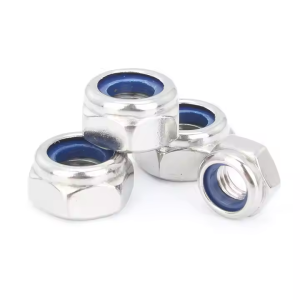
They are used where a prevailing torque feature is required. Their suitability depends on operating temperature, installation conditions, and reuse requirements.
ISO 7040:2025 specifies characteristics for regular hexagon nuts with non-metallic inserts. ISO 7719:2025 covers regular all-metal prevailing torque hexagon nuts.
All-metal lock nuts
All-metal lock nuts use a specially designed or deformed metal thread section to create prevailing torque.
They may be considered where non-metallic inserts are unsuitable, subject to the specified functional and operating requirements.
Neither design should be selected solely because an application involves vibration. The required locking performance and complete joint design must also be evaluated.
2.6 Slotted and Castellated Hex Nuts
Slotted and castellated nuts have slots or castellations around their upper section.
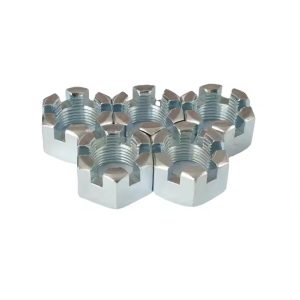
These features allow the nut to be used with a compatible drilled bolt or stud and a retaining component, such as a cotter pin.
After installation, the retaining pin passes through the hole in the bolt or stud and engages with the nut slots.
This arrangement provides a positive mechanical retention method in applications designed for it.
Important selection factors include:
- Compatibility between the nut slots and bolt hole
- Correct positioning of the retaining pin
- Applicable dimensional requirements
- The intended assembly and inspection procedure
Slotted and castellated nuts are not interchangeable with ordinary hex nuts simply because they have a similar external shape.
2.7 Comparison of Common Hex Nut Designs
| Hex Nut Design | Main Structural or Functional Feature | Main Selection Consideration |
| Standard hex nut | Conventional hexagonal body | General bolted connections |
| Heavy hex nut | Larger and heavier geometry | Specified structural and industrial assemblies |
| Thin hex nut | Reduced nut height | Jam nut arrangements and limited space |
| Hex flange nut | Integrated bearing flange | Bearing surface and joint design |
| Nylon insert lock nut | Non-metallic locking insert | Prevailing torque and temperature requirements |
| All-metal lock nut | Metal locking feature | Functional performance and operating conditions |
| Slotted or castellated nut | Slots for retaining pins | Positive mechanical retention |
The appropriate design depends on the assembly requirements, applicable product standard, and operating conditions.
3. Hex Nut Specifications and Dimensions
Understanding hex nut specifications is essential when comparing products, preparing purchase orders, and checking bolt compatibility.
A complete specification should identify more than the nominal thread diameter. Buyers may also need to confirm thread pitch, dimensional standard, nut style, tolerance, material, and mechanical property requirements.
3.1 Understanding Hex Nut Dimensions
Several dimensional parameters are commonly used to identify hex nuts.
Nominal thread diameter
This identifies the designated size of the internal thread. It is commonly expressed in millimeters for metric fasteners or inches for inch-series fasteners.
Thread pitch
Thread pitch is the distance between corresponding points on adjacent threads, measured parallel to the thread axis.
For metric threads, pitch is normally expressed in millimeters. A smaller pitch indicates closer spacing between adjacent threads.
Width across flats
Width across flats is the distance between two opposite flat surfaces of the hexagonal body.
This dimension determines the wrench opening required for installation or removal.
Nut height
Nut height is the axial dimension of the nut. It varies according to the nut design and applicable dimensional standard.
Thread tolerance
Thread tolerance defines the permitted dimensional variation affecting the fit between internal and external threads.
These parameters should be checked against the applicable product standard or approved technical drawing.
3.2 Metric and Inch Hex Nut Specifications
Hex nuts are manufactured for different thread measurement systems. Two commonly encountered systems are metric and inch-series threads.
Metric hex nuts
Metric threads use millimeters to identify nominal diameter and thread pitch.
A metric thread designation typically includes:
- The letter M
- Nominal thread diameter
- Thread pitch when specified
For example, an M12 designation identifies a metric thread with a nominal diameter of 12 mm. The pitch must also be confirmed when a particular thread configuration is required.
Inch-series hex nuts
Inch-series threads commonly use designations based on nominal diameter and threads per inch (TPI).
Common Unified thread systems include:
- UNC: Unified National Coarse
- UNF: Unified National Fine
The nominal diameter and thread count must be considered together when identifying an inch-series nut.
Metric and inch-series threads should not be assumed to be interchangeable, even when their nominal diameters appear similar.
3.3 How to Read Hex Nut Size Specifications
Product descriptions, technical drawings, and purchase specifications may use different formats to identify hex nut sizes.
For accurate identification, buyers should look for:
- Thread system, such as metric or Unified inch series.
- Nominal thread diameter.
- Thread pitch or threads per inch.
- Nut style and dimensional standard.
- Material and mechanical property requirements, where applicable.
A designation containing only a nominal diameter may not provide enough information for procurement.
For example, an order specifying an M12 hex nut may still require clarification of thread pitch, product standard, material, and property class.
A complete specification reduces the risk of receiving products that have the correct nominal diameter but do not meet the actual assembly requirements.
4. Hex Nut and Bolt Compatibility: What Buyers Need to Check
Selecting a hex nut and bolt as a matching pair is one of the most important steps in fastener procurement.
Two products may look similar and have the same nominal diameter but still be incompatible because of differences in thread pitch, thread system, tolerance, or other technical requirements.
Before ordering, buyers should verify the following factors.
4.1 Match the Thread Diameter and Pitch
The internal thread of the hex nut must match the external thread of the bolt.
Two essential parameters are:
- Nominal thread diameter
- Thread pitch
The nominal diameter identifies the designated thread size, while the pitch determines the spacing between adjacent threads.
For example, two metric bolts may have the same nominal diameter but different pitches. A nut designed for one pitch should not be assumed to fit the other.
For this reason, buyers should specify both diameter and pitch rather than relying on nominal diameter alone.
4.2 Check Thread Systems and Tolerance Classes
The thread system is another important compatibility factor.
Common systems include:
- ISO metric threads
- UNC threads
- UNF threads
Metric and Unified inch-series threads use different dimensional conventions and thread profiles. Products from these systems should not be mixed without a specifically verified engineering basis.
Thread tolerance also affects the fit between the nut and bolt.
For metric fasteners, ISO 965 provides relevant thread tolerance requirements. The specified internal and external thread tolerance classes should be checked against the application requirements.
Other factors to verify include:
- Coarse or fine thread configuration
- Right-hand or left-hand thread direction
- Applicable thread tolerance
- Manufacturing and inspection requirements
A suitable thread combination should allow proper engagement without excessive looseness or unacceptable interference.
4.3 Check Nut and Bolt Product Standards
Product standards define important characteristics such as dimensions, thread requirements, and other technical specifications.
However, the nut and bolt do not necessarily use the same standard number.
For example, a dimensional standard may specify the nut geometry, while another standard defines its mechanical properties.
When checking compatibility, buyers should confirm:
- The dimensional standard for the nut.
- The applicable dimensional standard for the bolt.
- The thread system and tolerance requirements.
- The mechanical property requirements for both components.
- Any additional requirements specified in the engineering drawing or purchase order.
Using products that comply with their respective standards does not automatically guarantee compatibility. Their specifications must still be suitable for the same assembly.
4.4 Match Mechanical Properties and Material Requirements
Mechanical property compatibility is particularly important in structural and industrial bolted connections.
A nut and bolt must be selected as parts of a compatible fastening system. Their mechanical properties should meet the requirements of the applicable design and standards.
For carbon and alloy steel nuts, ISO 898-2 addresses mechanical and physical properties and provides requirements related to suitable mating fasteners.
For corrosion-resistant stainless steel nuts, ISO 3506-2 specifies the relevant material grades and property classes.
These standards use different classification systems, so their grade or property class designations should not be compared as if they were directly interchangeable.
Buyers should confirm:
- Applicable material standard
- Required property class or grade
- Nut dimensions and style
- Compatible bolt requirements
- Operating temperature and environmental conditions
Material compatibility should also be considered. Carbon steel, alloy steel, and stainless steel have different mechanical and corrosion-related characteristics.
In corrosive environments, material selection should account for the operating conditions and the possibility of galvanic corrosion between dissimilar metals.
4.5 Check Nut Height and Thread Engagement
Nut height affects the available internal thread engagement between the nut and bolt.
A regular hex nut, heavy hex nut, and thin hex nut may have different heights even when they share the same nominal thread diameter.
The selected nut must provide adequate thread engagement for the intended connection.
When reviewing this requirement, buyers and engineers should consider:
- Nut height
- Bolt thread length
- Number of engaged threads
- Joint geometry
- Required mechanical performance
Thin nuts require particular attention because their reduced height can result in lower loadability than regular or high nuts.
They should not be substituted into a load-bearing assembly without confirming that the application permits their use.
4.6 Hex Nut and Bolt Compatibility Checklist
| Compatibility Factor | What Buyers Should Verify |
| Thread diameter | Matching nominal diameter |
| Thread pitch | Matching specified pitch |
| Thread system | Compatible metric or inch-series threads |
| Thread tolerance | Suitable internal and external thread fit |
| Nut and bolt standards | Applicable product requirements |
| Mechanical properties | Suitable property classes and performance requirements |
| Mea | Appropriate material combination |
| Nut height | Adequate thread engagement |
| Surface finish | Compatible coating and assembly requirements |
The most reliable approach is to review the complete nut and bolt specifications together before placing an order.
5. Hex Nut Materials, Grades and Surface Finishes
The material and surface finish of a hex nut affect its suitability for different operating environments and fastening requirements.
Buyers should evaluate these factors together with the selected bolt rather than choosing a nut based only on price or appearance.
5.1 Common Materials Used for Hex Nuts
Carbon steel
Carbon steel hex nuts are widely used in general industrial fastening applications.
They are available in different mechanical property classes and surface finishes. The appropriate specification depends on the required strength, operating environment, and applicable standard.
Alloy steel
Alloy steel nuts are used in applications requiring particular mechanical properties under specified conditions.
Their suitability depends on material composition, heat treatment, product dimensions, and applicable mechanical property requirements.
Stainless steel
Stainless steel hex nuts are commonly selected for applications where corrosion resistance is an important consideration.
Different stainless steel families have different corrosion and mechanical characteristics.
For example, austenitic, ferritic, martensitic, and duplex stainless steels should not be treated as having identical properties.
Selection should reflect the actual operating environment and the requirements of the complete fastener assembly.
5.2 Understanding Hex Nut Grades and Mechanical Properties
Hex nut grades and property classes identify mechanical requirements under specific standards.
For carbon and alloy steel nuts, ISO 898-2 specifies relevant property classes and mechanical requirements.
For corrosion-resistant stainless steel nuts, ISO 3506-2 provides the applicable grades and property classes.
The two standards use different classification systems, so their designations should not be treated as directly interchangeable.
When selecting a hex nut, buyers should confirm:
- Applicable material standard
- Required property class or grade
- Nut style and dimensions
- Compatible bolt requirements
- Operating temperature and environmental conditions
The correct nut specification should be determined from engineering requirements and relevant standards.
5.3 Common Surface Finishes for Hex Nuts
Surface treatment is another important consideration, especially when fasteners are exposed to moisture, chemicals, or outdoor conditions.
Zinc plating
Zinc plating provides a protective coating commonly used on carbon steel fasteners. Its corrosion protection depends on coating specifications, thickness, passivation, and exposure conditions.
Hot-dip galvanizing
Hot-dip galvanizing provides a thicker zinc coating than many conventional electroplated finishes.
However, coating thickness can affect thread dimensions and assembly fit. Nuts and bolts intended for hot-dip galvanized assemblies should be specified and manufactured according to applicable requirements.
Black oxide
Black oxide is a conversion coating used on certain steel fasteners. It provides a dark appearance and may offer limited corrosion protection when combined with suitable supplementary treatments.
Plain or as-processed finish
Some hex nuts are supplied without an additional protective coating. Their suitability depends on the base material and operating environment.
5.4 How to Choose the Right Material and Finish
A practical selection process should consider four main factors:
- Operating environment: Determine whether the fastener will be exposed to moisture, chemicals, outdoor conditions, or other corrosive elements.
- Mechanical requirements: Confirm the necessary property class and compatibility with the mating bolt.
- Surface treatment: Select a finish appropriate for the required corrosion protection and dimensional tolerances.
- Assembly conditions: Check whether the coating affects thread engagement, tightening, or intended joint performance.
For demanding applications, buyers should specify material and coating requirements clearly in the technical documents rather than using general descriptions such as high-strength or corrosion-resistant.
6. Hex Nut Standards and Specification Documents
Standards provide a common technical basis for identifying and manufacturing hex nuts.
However, different standards address different aspects of the product. Some define dimensions and geometry, while others specify mechanical properties or functional performance.
Understanding these differences helps buyers review technical documents more accurately.
6.1 Common Standards for Hex Nuts
The following standards are relevant examples for different hex nut products and requirements.
| Standard | Main Subject | Application |
| ISO 4032:2023 | Hexagon regular nuts, style 1 | Metric regular hex nuts |
| ISO 4033:2023 | Hexagon high nuts, style 2 | Metric high hex nuts |
| ISO 4035:2023 | Hexagon thin nuts, style 0 | Metric thin hex nuts |
| ISO 7040:2025 | Prevailing torque regular hex nuts with non-metallic insert | Metric coarse-thread lock nuts |
| ISO 7719:2025 | Prevailing torque regular hex nuts, all-metal | Metric coarse-thread all-metal lock nuts |
| ISO 898-2:2022 | Mechanical properties of carbon and alloy steel nuts | Property classes and mechanical requirements |
| ISO 3506-2:2020 | Mechanical properties of corrosion-resistant stainless steel nuts | Stainless steel grades and property classes |
| ISO 2320:2015 | Functional properties of prevailing torque steel nuts | Prevailing torque and related functional testing |
| ASME B18.2.2-2022 | Inch-series nuts for general applications | Inch-series dimensional requirements |
| ASTM A563/A563M-26 | Carbon and alloy steel nuts | Chemical, mechanical, and dimensional requirements |
These standards should not be treated as interchangeable.
For example, ISO 4032 specifies characteristics of regular hex nuts, while ISO 898-2 addresses mechanical and physical properties for relevant carbon and alloy steel nuts.
Similarly, ASME B18.2.2 covers inch-series nut dimensions, whereas ASTM A563/A563M covers specified chemical, mechanical, and dimensional requirements for carbon and alloy steel nuts.
ISO 2320 addresses the functional properties of prevailing torque steel nuts. It should not be confused with a dimensional standard for ordinary hex nuts.
The exact edition and applicable requirements should always be confirmed before ordering. Standards can be revised, and purchase specifications may refer to a particular edition.
6.2 What Should Be Included in a Hex Nut Specification Sheet?
A complete hex nut specification sheet should contain enough information for a supplier to identify the correct product.
Important details include:
| Specification Item | Information to Provide |
| Product type | Standard, heavy, flange, lock, or another specified design |
| Nominal size | Thread diameter |
| Thread pitch | Metric pitch or threads per inch |
| Thread system | Metric, UNC, UNF, or another specified system |
| Product standard | Applicable dimensional standard and edition |
| Mea | Carbon steel, alloy steel, stainless steel, etc. |
| Property class or grade | Applicable mechanical classification |
| Surface finish | Zinc plating, hot-dip galvanizing, black oxide, or other finish |
| Tolerance | Required dimensional and thread tolerances |
| Quantity | Required purchasing quantity |
| Packaging | Agreed packaging and labeling requirements |
For special applications, buyers may also need to provide engineering drawings, inspection requirements, and additional technical documentation.
6.3 How to Verify Hex Nut Standards Before Ordering
Before confirming a purchase order, buyers should review the product specifications systematically.
Step 1: Confirm the standard designation
Check that the product standard matches the required nut type and dimensional system.
Step 2: Verify the standard edition
Different editions may contain revised dimensions or technical requirements. The purchase documents should identify the intended edition where necessary.
Step 3: Review dimensional requirements
Check the nominal diameter, thread pitch, width across flats, nut height, and relevant tolerances.
Step 4: Confirm material and mechanical properties
Ensure that the specified material and property class correspond to the application and mating bolt.
Step 5: Check surface treatment requirements
Confirm the coating type and any dimensional or functional requirements associated with the finish.
Step 6: Compare technical documents
The product drawing, technical specification, purchase order, and inspection documents should contain consistent information.
This process helps reduce specification misunderstandings and makes it easier to verify whether delivered products meet the agreed requirements.
7. What to Consider When Purchasing Hex Nuts
For industrial buyers and fastener distributors, purchasing hex nuts involves more than comparing unit prices.
Product specifications, consistency, documentation, packaging, and compatibility with the intended bolts all influence the suitability of an order.
7.1 Confirm Product Requirements Before Ordering
Before requesting a quotation, prepare a clear product specification.
The information should include:
- Hex nut type
- Nominal thread diameter
- Thread pitch
- Thread system
- Applicable dimensional standard
- Material and property class
- Surface finish
- Required quantity
- Packaging and labeling requirements
If the nuts are intended for use with specific bolts, provide the corresponding bolt specifications as well.
This allows the supplier to evaluate the complete fastening combination rather than quoting a product based on incomplete information.
7.2 Review Samples and Quality Documentation
For new suppliers, customized requirements, or large-volume orders, reviewing samples and relevant quality documentation can help confirm product suitability.
Depending on the purchase specification, buyers may consider checking:
- External appearance and workmanship
- Key dimensional measurements
- Thread size and pitch
- Thread fit with a compatible gauge or approved mating fastener
- Material identification and supporting documentation
- Mechanical property inspection records, where required
- Surface finish and coating consistency
Inspection requirements should be agreed upon before production or shipment.
Not every order requires the same testing procedure. The appropriate inspection scope depends on the product standard, application, contractual requirements, and risk level.
7.3 Check Packaging, Labeling and Batch Consistency
Packaging and labeling are important for industrial orders containing multiple hex nut sizes or specifications.
Before shipment, buyers should confirm that:
- Different sizes and types are properly separated.
- Product labels match the agreed specifications.
- Package quantities are clearly identified.
- Material and property class information is correctly stated where required.
- Manufacturing or batch identification is available when specified.
- Packaging provides adequate protection during storage and transportation.
Clear labeling helps reduce receiving errors and makes inventory management easier for distributors and industrial users.
7.4 Hex Nut Purchasing Checklist
Before confirming an order, use the following checklist:
- Confirm the required hex nut type.
- Verify the nominal thread diameter and pitch.
- Identify the correct thread system.
- Specify the applicable dimensional standard and edition.
- Confirm material and mechanical property requirements.
- Define the required surface finish.
- Check compatibility with the mating bolt.
- Review samples and inspection documents when necessary.
- Confirm packaging, labeling, and batch identification.
A complete specification provides a more reliable basis for quotation, production, inspection, and delivery.
Conclusion: How to Choose the Right Hex Nuts
Choosing the right hex nuts requires attention to product design, dimensions, thread specifications, materials, mechanical properties, and applicable standards.
Standard hex nuts, heavy hex nuts, thin nuts, flange nuts, lock nuts, and slotted nuts have different structural features and selection considerations. They should not be treated as interchangeable simply because they share a hexagonal exterior.
For reliable bolted connections, thread diameter and pitch must match, while thread systems, tolerances, mechanical properties, and material requirements must also be considered.
Industrial buyers should provide complete specifications, review relevant technical documents, and confirm compatibility with the intended bolts before placing an order.
When sourcing industrial fasteners, reviewing nut and bolt specifications together helps identify suitable components for the intended assembly. Clear product specifications and purchasing requirements are the starting point for selecting the right fastening combination.
Frequently Asked Questions About Hex Nuts
1. What Are the Most Common Types of Hex Nuts?
Common designs include standard hex nuts, heavy hex nuts, thin or jam nuts, hex flange nuts, hex lock nuts, and slotted or castellated nuts.
They differ in body dimensions, thickness, bearing surfaces, and locking features. The appropriate design depends on the assembly and applicable product requirements.
2. How Do I Know Which Hex Nut Fits My Bolt?
Check the nominal thread diameter, thread pitch, thread system, and tolerance requirements.
You should also verify the applicable product standards and mechanical property requirements. Matching the nominal diameter alone is not sufficient to establish compatibility.
3. What Is the Difference Between Standard and Heavy Hex Nuts?
Heavy hex nuts have larger and heavier dimensions than corresponding regular hex nuts under their respective standards.
Their width across flats and nut height may differ. The correct choice depends on the specified bolt assembly and applicable dimensional and mechanical requirements.
4. Are Metric and Inch Hex Nuts Interchangeable?
No. Metric and inch-series threads use different dimensional systems and thread specifications.
Even when nominal diameters appear similar, thread pitch and profile may differ. Always verify the complete thread designation before selecting a mating nut and bolt.
5. How Do I Choose the Right Hex Nut Material?
Consider the operating environment, mechanical requirements, corrosion exposure, and compatibility with the mating bolt.
Carbon steel, alloy steel, and stainless steel nuts have different characteristics. The material and property class should be selected according to the relevant standard and application requirements.
6. Which Standards Should I Check When Buying Hex Nuts?
Relevant standards depend on the product and application.
Examples include ISO 4032:2023 for regular hex nuts, ISO 4033:2023 for high hex nuts, ISO 4035:2023 for thin hex nuts, ISO 898-2:2022 for mechanical properties of carbon and alloy steel nuts, and ISO 3506-2:2020 for stainless steel nuts.
For inch-series products, ASME B18.2.2-2022 and applicable ASTM specifications may also be relevant.
Always confirm the standard edition, scope, and purchasing requirements before placing an order.












